3 February 2013
Special Study Circle: Food and Guest Speaker
To be updated soon (with pictures), I/A
Speaker Details:
(Who kindly filled in at extremely short notice)
Kamran Hussain
A family man with a loving wife and 4 beautiful children (MA) who has spent time learning about Islam since his early twenties, which included living in Qatar until 5 years ago. He is currently the regular Khatib for the National Grid and works as a Manager of Strategy and Systems Planning. In addition, Kamran is a Trustee of iERA (Islamic Education and Research Academy) and previously edited the Jumuah Magazine.
Hadith:
Abu Sa`id Al-Khudri (May Allah be pleased with him) reported: Prophet of Allah (sallallahu alayhi wassallam) said: "There was a man from among a nation before you who killed ninety-nine people and then made an inquiry about the most learned person on the earth. He was directed to a monk. He came to him and told him that he had killed ninety-nine people and asked him if there was any chance for his repentance to be accepted. He replied in the negative and the man killed him also completing one hundred. He then asked about the most learned man in the earth. He was directed to a scholar. He told him that he had killed one hundred people and asked him if there was any chance for his repentance to be accepted. He replied in the affirmative and asked, `Who stands between you and repentance? Go to such and such land; there (you will find) people devoted to prayer and worship of Allah, join them in worship, and do not come back to your land because it is an evil place.' So he went away and hardly had he covered half the distance when death overtook him; and there was a dispute between the angels of mercy and the angels of torment. The angels of mercy pleaded, 'This man has come with a repenting heart to Allah,' and the angels of punishment argued, 'He never did a virtuous deed in his life.' Then there appeared another angel in the form of a human being and the contending angels agreed to make him arbiter between them. He said, `Measure the distance between the two lands. He will be considered belonging to the land to which he is nearer.' They measured and found him closer to the land (land of piety) where he intended to go, and so the angels of mercy collected his soul".
[Al-Bukhari and Muslim]
In another version: "He was found to be nearer to the locality of the pious by a cubit and was thus included among them". Another version says: "Allah commanded (the land which he wanted to leave) to move away and commanded the other land (his destination) to draw nearer and then He said: 'Now measure the distance between them.' It was found that he was nearer to his goal by a hand's span and was thus forgiven". It is also narrated that he drew closer by a slight movement on his chest.
Commentary:
1. One comes to know from this Hadith that the gate of Taubah is open even for the worst of the sinners; and Allah forgives everyone provided he repents sincerely, the conditions for such repentance have already been discussed.
2. It is the duty of a religious scholar that while discussing a problem, he should keep in mind the psychological aspects of the questioner and adopt a policy which neither causes a change in the Injunction of Allah nor make the sinner reckless in his sins out of frustration.
3. When a situation warrants, angels appear in the form of men on Orders of Allah.
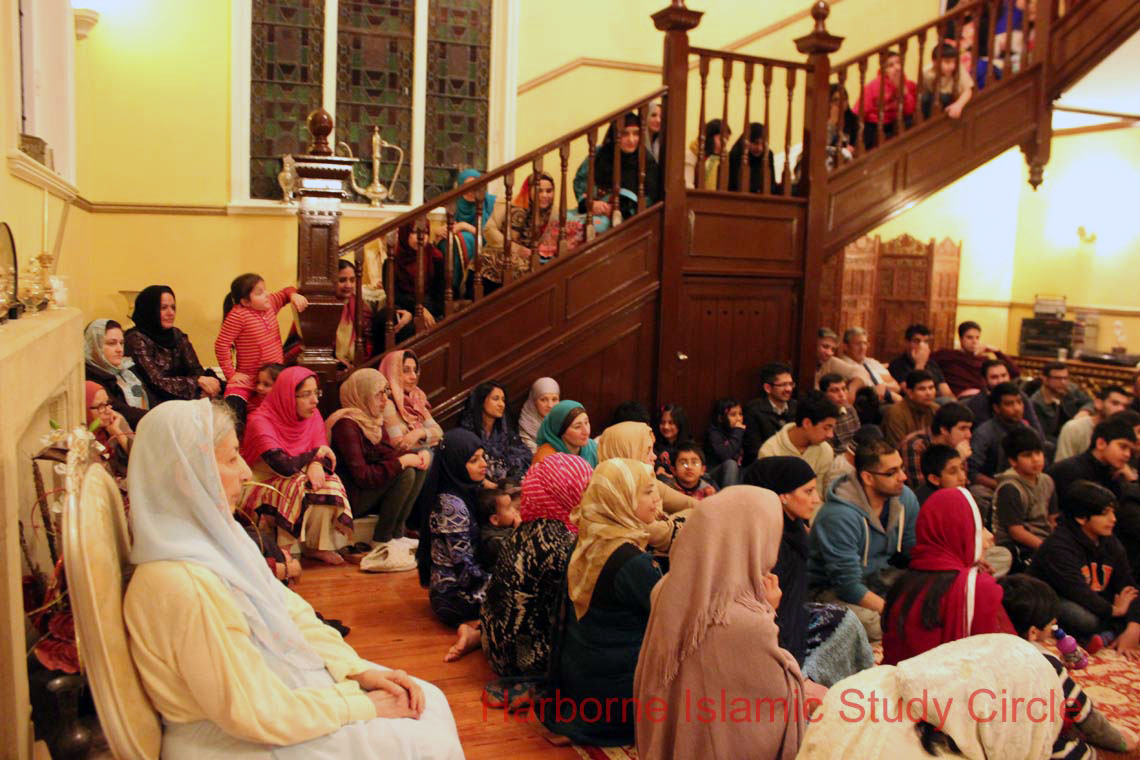
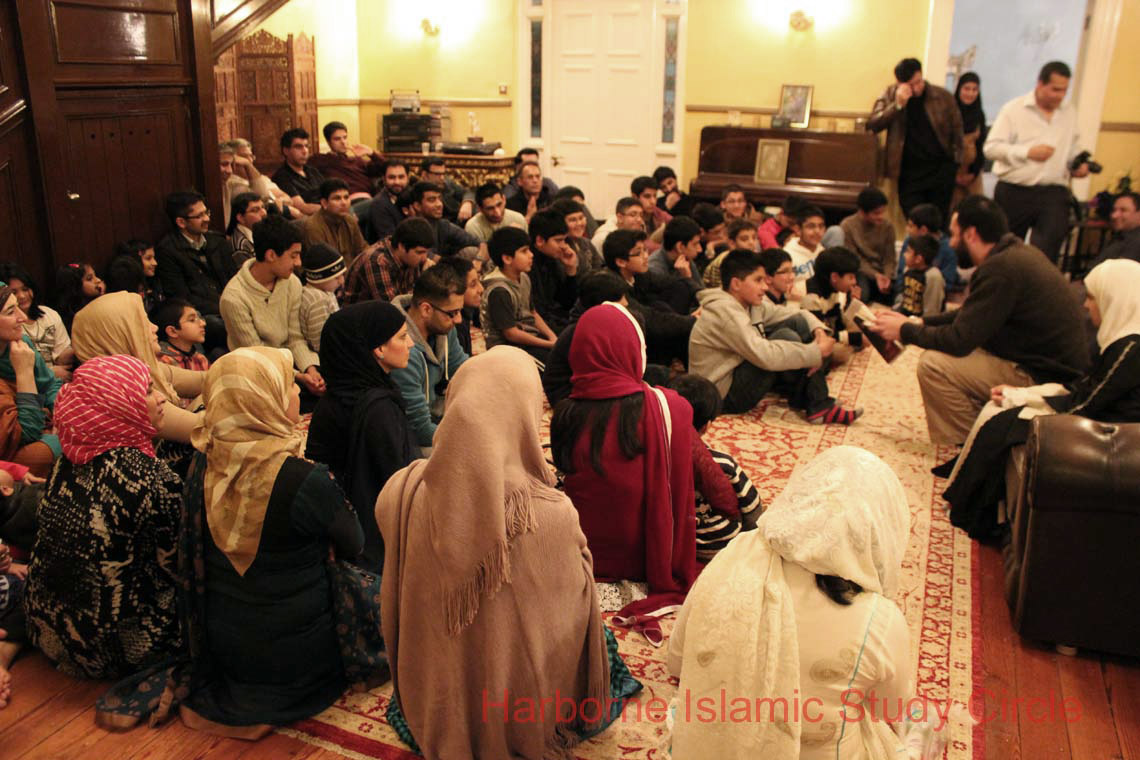
Pictures from the evening
18 November 2012
Happy New Year - 1434
Summary
Seerah: Najran Delegation and the death of the Prophet*’s son (Ibrahim)
The Delegation of the Christians of Najran
False Christian belief in Jesus being a God and 'Original Sin'
Christians debated with the Prophet* and stayed in his masjid
Quranic Ayah revealed and challenged the Christians with a curse for the liars
Christians agree a peace treaty and to pay Jizyah
2 men from Bani ‘Amir bin Sa‘sa‘a try to kill the Prophet*, one dies of illness and the other struck by lightning
Death of the Prophet*’s Son (Ibrahim) followed by coincidental eclipse
What is Qur’an
Qur’an is from the word Qara’a = to read or recite
Qur’an linguistically means the book that has been read or recited.
Shariah term, Qur’an: 'is Allah’s miraculous speech revealed unto Muhammad* in Arabic and transferred to us by the Tawatur method'
Revelation of the Qur’an in stages over 23 years
Arrangement and verified by Jibreel and Prophet*
Compiled into book later
Has clearcut and ambiguous meanings
Asbaab an-nuzool (Circumstances of revelation)
The types of abrogation
Seerah of Muhammed*
*: May the peace blessings and Mercy of Allah be upon him
TMQ: Translation to the nearest meaning of the Qur’an
The Delegation of the Christians of Najran
Many delegations of major Arab tribes are now reaching Medina, some asking for power others for friendship with whole tribes declaring acceptance of Islam. One with a special significance was from Najran. At the time of the Prophet*, Najran and its surrounding area, in the south of Arabia, was a Christian valley. It had a Bishop called Abu Harithah ibn ‘Alqamah who was considered an authority on the Christian faith. He was in touch with Byzantine emperors who respected him, sent him financial aid and helped build a number of churches in the area. In response to a letter sent by the Prophet* inviting them to Islam they sent a delegation of 60 people to Medina in order to get first-hand information about the Prophet*.
The Najranis had sympathy with much of Muhammad’s teaching, and admired the religious practices he was inaugurating – but they were concerned to defend the role of Jesus as the Divine Son of God, the second ‘person’ in their Holy Trinity. All Christian theologians, no matter to which branch of the Christian Church they belonged, understood that the entire edifice of Christianity as it was then being propounded depended on the literal acceptance of the doctrine of an original sin, which was then passed on to all humanity by inheritance, from which it was impossible for any human being, no matter how devout, to escape without extra Divine help. Thus, it was a necessary part of the faith that God Himself should become incarnate in human flesh, a being that was both God and Man – and therefore more than Man - to bring about the means for Man to escape the clutches of original sin; but at the same time he had to be part of humanity, so that Man might logically be the one paying the redemption for that sin. Jesus, they reasoned, was this God-Man, and the whole point of his incarnation on earth was in order to die as a sacrifice of God Himself, to God Himself, to save or redeem humanity from its impossible situation.
Once this doctrine of original sin was questioned, or the free grace and compassion of God accepted so that there was no need of sacrificial redemption from sin, then the notion of an incarnate saviour became unnecessary and nonsensical. The whole edifice of Christianity would be undercut – and this was the very real danger the Christian intellectuals grasped immediately. So, the Christians defended Trinitarianism and the divinity of Jesus, whereas Muhammad called them to recognise the Oneness of God and the spiritual unity of all humanity.
The Christians allowed to camp in the Medina Mosque
The Christians were treated with the utmost hospitality, and to allay their fears were allowed to have their tents erected in the security of Prophet*’s mosque, where they had all provisions of food and drink supplied to them. They made ready to meet him by taking off their travel (secular) clothes and putting on their ceremonial robes of fine silk embroidered with crosses, and gold rings. However, when they greeted the Prophet* he did not respond. They continued to wait on, and at the end of the day went to find Uthman b. Affan and Abdu’r Rahman b. Awf, who were known to them. They explained they had waited all day, and did not know what they were supposed to do. They had received the Prophet*’s letter and responded – should they now go home again, without speaking to him? Ali, who was with Uthman and Abdu’r Rahman, suggested they should take off their copes and rings, and try again. Sure enough, when the Prophet* approached him the next time, they were successful.
When meeting with the Prophet* he, after returning their greetings, spoke to them in his friendly manner. When the time came for the asr prayer, they also prayed, facing the east, the Prophet* allowing them to do so. They assured the Prophet* that they did not intend to change their faith, but wanted to hear what he had to say about Jesus. He told them that he had nothing to say that day, but they should wait. The next morning the Christians came forward, led by the Bishop.
‘O Muhammad,’ the Bishop opened, ‘Tell us what it is that you say about the Lord, the Messiah?’ ‘He is a servant of God,’ replied the Prophet*, ‘one chosen by God, and who answered Him.’ ‘Do you know whether his birth was caused by a father?’ ‘He was not born of human intercourse,’ replied the Prophet*, ‘so he could not have a father.’ ‘Then how can you say that he is a servant who has been created, when you consider all created servants to have been born as the result of human intercourse, and to have fathers?’
The Prophet* said, “I have nothing to say about him today. You have to stay until I can tell you what will be said to me about Jesus, peace be upon him.”
Revelation about Jesus (‘Isa)
Next morning, the Prophet* received fresh Qur’anic revelations which stated: “Jesus, in God’s view, is the same as Adam, whom He had created from dust and said to him: ‘Be’, and he was there. This is the truth from your Lord. Be not, therefore, one of the doubters. Should anyone argue with you about him after what has been given to you of true knowledge, say to them: let us call in our children and your children, our women and your women, and ourselves and yourselves. Let us then all pray God and ask that God’s curse overwhelm the liars.” (Al-Imran 3: 59-61)
When the Prophet* told the Najran delegation the following day what information he had received about Jesus, they refused to accept it. The Prophet* then offered them the challenge which was outlined in the Qur’anic verses quoted above. It was a serious challenge. It meant for the Najran people that they risked being cursed by a Prophet* and a Messenger of God. Such a prospect was not to be trifled with.
The Challenge of a Mubahalah and Treaty Signed
The Prophet* recited this to the Christians. Next the angel revealed that he should issue the challenge of a mubahalah, that they should pray, and let the One True God send His curse on the party which was not declaring the truth.
The Najrani leaders held a consultation, and decided to act cautiously - for if the Prophet* truly was a Messenger of God, they would have invoked disaster upon themselves. Their unanimous view was to wait until the following morning, and then watch carefully to see what the Prophet* did. If he came out with his children and his family showing he had the confidence to risk their safety, then they would withdraw from the contest of prayer; but if he came out defended by Companions ready to support him, then they should let the contest go ahead, for in that case, he would be showing that he did not have real confidence.
So the Christians came out early with the Bishop at their head, to see whether or not the Prophet* would emerge with his family. He came out holding the hand of a younger man, two little boys walked in front of him (and scurried shyly beneath his cloak when he stopped), and a woman followed behind.
‘Who are these people?’ asked the Bishop. ‘That is his cousin Ali b. Abu Talib, who is also his son-in-law and the father of his two grandsons,’ he was told, ‘the most beloved of all creatures to him. Those children are the sons of his daughter by Ali. That woman is his daughter, Fatimah, the dearest of people to him and the closest to his heart.’ The Bishop looked at the other Christian leaders. ‘He has come out with the special members of his family, trusting in his own truthfulness,’ he said. ‘By God, he would not have come with them if he was afraid that the proof would be against him.’ The others agreed. So the Bishop called out that they would not make a contest of prayer, but would make peace with him.
The Messenger of Allah* then admitted that agreement and ordered them to pay Al-Jizya (i.e. tribute) and he made peace with them for the provision of two thousand garments, one thousand of them to be delivered in Rajab, the other thousand ones in Safar. With every garment they had to pay an ounce (of gold). In return they will have the covenant of Allah and His Messenger*. He gave them a covenant that provides for practicing their religious affairs freely. They asked the Prophet* to appoint a trustworthy man to receive the money agreed on for peace, so he sent them the trustworthy man of this nation Abu ‘Ubaidah bin Al- Jarrah to receive the amounts of money agreed on in the peace treaty. By the time Islam started to spread in Najran, naturally, they did not have to pay Al-Jizya that usually non-Muslims paid. Whatever the case was, it was said that Al-Aqib and As-Saiyid embraced Islam as soon as they reached Najran on their journey back home. It is also said that the Prophet* sent to them ‘Ali too, for the collection of charities and tribute.
The terms of the peace agreement:
In the name of God, the Merciful, the Beneficent. This is what Muhammad, the Prophet* and God’s Messenger, has written down for the people of Najran when he has the authority over all their fruits, gold, silver, crops and slaves. He has benevolently left them all that in return for 2,000 hullas every year, 1,000 to be given in the month of Rajab and 1,000 in the month of Safar. Each hulla is equal to one ounce [a measure equal to 4 dirhams]. The Najran are also required to provide accommodation and expenses for my messengers, for up to 20 days. None of my messengers shall be kept in Najran more than one month. They are also required to give, as a loan, 30 shields, 30 horses and 30 camels, in case of any disorder and treachery in Yemen. If anything is lost of the shields, horses or camels they loan to my messenger, it will remain owing by my messenger until it is given back. Najran has the protection of God and the pledges of Muhammad, the Prophet*, to protect their lives, faith, land, property, those who are absent and those who are present, and their clan and allies.
They need not change anything of their past customs. No right of theirs or their religion shall be altered. No bishop, monk or church guard shall be removed from his position. Whatever they have is theirs, no matter how big or small. They are not held in suspicion and they shall suffer no vengeance killing. They are not required to be mobilized and no army shall trespass on their land. If any of them requests that any right of his should be given to him, justice shall be administered among them. He who takes usury on past loans is not under my protection. No person in Najran is answerable for an injustice committed by another.
It is useful to mention here that should a follower of an earlier religion state that Muhammad is a Prophet* or a Messenger of God, his statement does not bring him into the fold of Islam. This statement is not sufficient to make him a Muslim. What it signifies is that the man knows that Muhammad* is a messenger of God, but to be a Muslim is much more than mere knowledge, even when it is expressed in words and statements. To be a Muslim is to believe in God’s oneness and in the message of Muhammad* and to accept that in practice, making obedience to God and to the Prophet*, in public and in private, one’s way of life.
The Delegation of Bani ‘Amir bin Sa‘sa‘a
Among the group of delegates were ‘Amir bin At-Tufail — the enemy of Allah, Arbad bin Qais — Labid’s maternal brother, Khalid bin Ja‘far, and Jabbar bin Aslam. All of them were the leaders and satans of their people. ‘Amir was the one who doublecrossed the group of Ma‘una well. When this delegation made their mind to come to Medina, ‘Amir and Arbad conspired to kill the Prophet* . So when the group of delegates arrived, ‘Amir kept on talking to the Prophet* whereas Arbad turned aside trying to draw his sword. He managed to draw a span of hand long but Allah stilled his hand so that he was unable to proceed with its withdrawal. Allah protected the Prophet*. The Prophet* invoked Allah against them. So when they returned, Allah sent down a thunderbolt unto Arbad and his camel and he was burnt. As for ‘Amir he called at a house of a woman who was from Bani Salul and had a gland sore. He eventually died while he was saying: "What am I like? I have a gland similar to a camel’s. And here I am dying in the house of the woman from Bani Salul." In Sahih Al-Bukhari it is narrated that ‘Amir came to the Prophet* and said: "I grant you an opportunity to choose one of two: you will have the flat land people and I will have townspeople; or I will succeed you. Otherwise, I will invade your people with a thousand he-camels and a thousand shecamels." But, later on he got plague-stricken in a woman’s house. So he said: "What! I have a gland similar to a camel’s, and here I am in a woman’s house of Bani so and so people. Fetch me my mare!" He mounted it but died on its back.
Death of the Prophet*’s Son (Ibrahim)
The untroubled happiness of the early months of this year came to an end with the illness of Ibrahim. It was soon clear that he would not survive. He was tended by his mother and her sister Sirin, The Prophet* visited him continually, and was with him when he was dying. As the child breathed his last, he took him in his arms, and tears flowed from his eyes. His forbidding of vociferous lamentation had made prevalent the notion that all expressions of woe at bereavement were to be discouraged, and the mistaken idea still lingered on in many minds. "0 Messenger of God," said 'Abd ar-Rahrnan ibn 'Awf, who was present, "this is what thou hast forbidden. When the Muslims see thee weeping, they too will weep." The Prophet* continued to weep, and when he could find his voice he said: "Not this do I forbid. These are the promptings of tenderness and mercy, and he that is not merciful, unto him shall no mercy be shown. O Ibrahim, if it were not that the promise of reunion is sure, and that this is a path which all must tread, and that the last of us shall overtake the first, verily we should grieve for thee with a yet greater sorrow. Yet are we stricken indeed with sorrow for you, O Ibrahim. The eye weeps, and the heart grieves, nor say we anything that would offend the Lord."!
He spoke words of comfort now to Mariyah and Sirin, assuring them that Ibrahim was in Paradise. Then, having left them for a brief while, he returned with 'Abbas and Fa91. The young man washed the body and laid it out, while the two older men sat and watched him. Then it was borne forth to the cemetery on its little bier. The Prophet* led the funeral prayer and prayed again for his son at the edge of the grave after Usamah and Fadl had laid in it the body. When the earth had been heaped over it, he still lingered at the graveside, and calling for a skin of water he bade them sprinkle it over the grave. Some unevenness had been left in the earth, and noticing this he said: "When one of you doeth aught, let him do it to perfection." And smoothing it over with his hand, he said of his own particular action: "No harm it doth nor good, but it giveth relief unto the soul of the afflicted.":
He had already stressed more than once the need to make perfection one's aim in every earthly act, and many of his sayings indicate that this aim must be unworldly and detached. 'Ali is said to have summed up the Prophet*'s guidance in this respect as follows: "Do for this world as if to live for ever and for the next as if to die upon the morrow." To be always ready to depart is to be detached. "Be in this world as a stranger or as a passer-by," the Prophet* said.
On the day of Ibrahim's death, not long after his burial, there was an eclipse of the sun; but when some of the people attributed it to the Prophet*'s bereavement he said: "The sun and the moon are two signs of the signs of God. Their light is not dimmed for any man's death. Ifye see them eclipsed, ye should pray until they be clear."
Main Topic: What is the Qur’an?
What is the Qur’an?
It is necessary to define the Qur’an, from this definition we will know what is allowed to be read in prayer and what is not. What is a proof in Hukm Shara’i and what is not? It also tells us what makes somebody a Kafir due to what he denies and what does not constitute disbelief. So when we define Qur’an we mean the Qur’an as evidence in Fiqh.
Qur’an is derived from the word Qara’a, which means to read or recite. Therefore, Qur’an linguistically means the book that has been read or recited.
As a (Shariah) term, Qur’an is Allah’s miraculous speech revealed unto Muhammad* in Arabic and transferred to us by the Tawatur method.
The recitation of Qur’an is considered as an Ibadah (act of worship). By Allah’s speech it is meant that the Qur’an is the exact words of Allah. It was revealed to Muhammad* as it exists today. By ‘miraculous’ it is meant that no one can produce something similar to it. The term “in Arabic” refers to the language of the Qur’an, not to its scope or ideas because Qur’an addresses all Arabs and non-Arabs. The rules of Qur’an are universal and not restricted to one ethnic group or a specific area or time. All the Qu’ran is completely in Arabic and contains no foreign tongue. Furthermore, the ignorance of the Arabs about some words of the Quran is not evidence that the Quran contains foreign words. Rather there is a possibility that some non-Arabs learned some Arabic words and then it became wide spread in their language. Because of this some of their words may correspond to some words mentioned in the Quran, or maybe some foreign words entered in the Arabic language. And hence it became part of the Arabic language itself and therefore cannot be considered a foreign word anymore as the Arabs used it as part of their language, even if its root is foreign.
Many verses point that the Quran is completely in Arabic such as: “Verily, We have sent it down as an Arabic Qur’an.” (TMQ Yusuf: 2) “A Book whereof the Verses are explained in detail - a Qur’an in Arabic for people who know.” (TMQ Fussilat: 3) “An Arabic Quran with no crookedness in it, perchance they will be God fearing.” (TMQ Al-Zumar: 29) “We verily, have made it a Qur’an in Arabic.” (TMQ Zukhruf: 3)
By Tawatur method it is meant that a group or people for whom it is impossible to lie or conspire to fabricate a lie conveyed it to us. The Qur’an was transferred to us through an entire generation, not just by a group, to its successors, until it reached the present generation, without any interval in this transference.
Reciting Qur’an in Arabic by itself, without even comprehending its meaning is considered an Ibadah. In this regard, Qur’an is different from Hadith, which cannot be recited as an act of Ibadah. However, thinking about the meanings of both the Qur’an and Hadith is considered an Ibadah.
Revelation of the Qur’an
The Qur’an was revealed to Prophet* Muhammad* in parts for a period of twenty-three years. It used to be revealed in various ways. Sometimes the revelation would come in quick succession and other times it would take a long time. The Qur’an was revealed gradually and not all at once due to wisdom (Hikma) Allah has mentioned in the noble Qur’an itself: “And those who disbelieve say: ‘Why is not the Qur’an revealed to him all at once?’ Thus (it is send down in parts), that We may strengthen your heart thereby.” (TMQ Al-Furqan: 32)
So, in order to strengthen the heart of the Messenger*, and so as to recite it to the people slowly without haste, and also in order to reveal it according to incidents and answers to questions, the Qur’an was revealed gradually and in parts for twenty-three years.
As we mentioned in previous study circles the scholars have defined fiqh as ‘the knowledge of the practical Shariah rules that are derived from their detailed evidences’.
Qur’an and Shariah
Knowledge of the Shariah rules began the day when they were revealed by Allah. This took place mostly after the migration (Hijra) of the Prophet* from Mecca to Medina. The Prophet* stayed in Mecca for thirteen years, and then he resided in Medina for about ten years. The Quran was revealed in Mecca and continued throughout the Prophet*’s stay in Medina. Many of the verses of Ahkam (rules) were revealed in Medina. In this period verses from the Qur’an were revealed and the Messenger* used to convey the Ahkam relating to answering practical questions and providing solutions to problems that arose.
The portion that was revealed in Mecca is approximately about two thirds of the Qur’an and they are known as the Meccan verses (Makki). In their totality they barely deal with few Ahkam. Rather they are confined to explaining the fundamentals of the Deen and calling people to them, such as the belief in Allah and His Messenger, the Day of Judgement, the command to perform Salah, characterisation with moral attributes such as honesty, truthfulness, and forbidding evil actions such as fornication, murder, burying girls alive, deficiency in the measure and scales etc. The second portion that was revealed in Medina is close to a third of the Qur’an and they are known as the Medinan verses (Madani). These are verses of Mu'amalat (transactions) such as selling, renting and usury. They also include the Hudud, such as the Hadd of Zina (fornication) and stealing. They include the Jinayat (capital punishments) such as killing the one who killed someone intentionally or punishment of highway robbers and rules from the Bayyinat (testimonial evidences) such as the testimony of Zina and the rest of the testimonies. The remaining rules concerning the worships (Ibadat) such as fasting, Zakah, Hajj and Jihad were also revealed during this period.
Arrangement of the Qur’an
During the time of the Prophet*, the text of the Qur’an was preserved in memory and also inscripted on flat stones, wood, and bones. The Qur’an used to be revealed to the Prophet* and he used to instruct people to memorise it and write it down on pieces of leather, paper, scapula, palm risp, bones, leaf stalks of date palm etc. When the Ayat were revealed he used to give the order that they be placed in their proper place in the Surah (chapter). Thus, he used to say put this Ayah in such and such Surah after such and such Ayah. So they used to put them in their proper place in the Surah. It has been narrated by Uthman that he said, “The Ayat used to be revealed to the Prophet* and so he used to say: “Put these Ayat in the Surah which mentions such and such thing.” (Ibn Majah & Abu Dawud) It was done in this manner until the whole Qur’an was revealed and Allah took his* soul after the revelation of the Qur’an was complete. That is why the arrangement of the verses of every Surah in the form as it is in now in the present script (Mushaf) was determined by the revelation (Tawqeefan) from the Prophet* transmitted to him* by Jibreel from Allah. According to this arrangement the Ummah transmitted the Qur’an from the Prophet* and there is no dispute about this. The order of the verses within the chapters (Surahs) was in the same form as we see today.
Compilation of the Qur’an
This was covered is last week’s Study Circle
Open & Hidden meaning?
The noble Qur’an does not have a Zaahir (outer) or Baatin (secret) meaning as some claim. It is an Arabic speech, which has come in the tongue of the Arabs. He said: “We have sent it down as an Arabic Qur’an.” (TMQ Yusuf: 2) “In the plain Arabic language.” (TMQ Ash-Shu’ara: 195)
It is understood the same way as any Arabic speech is understood. What Allah intends by the Qur’an is what has been expressed by the noble Qur’an itself. Allah did not intend anything other than what was expressed. His intention is only understood from understanding of the syntax. The Arabic meaning is what Allah intended in His speech, which He expressed in the Arabic words and Arabic style. Accordingly, the import of the speech is what the speech indicated, through the linguistic proofs and the Shar’i indication mentioned in the Kitaab or Sunnah. This has no ‘outer’ or ‘inner’; it rather has a meaning indicated by the Arabic speech, through the understanding of the Arabic words and styles.
The Muhkamaat (clearcut) and Mutashaabihaat (ambiguous)
The Qur’an is composed of Ayat which are Muhkamaat (clearcut) and Ayat which are Mutashaabihaat (ambiguous), due to the saying of Allah: “In it are Verses that are entirely clear, they are the foundations of the Book; and others not entirely clear.” (TMQ Al-Imran: 7)
As for the Muhkam (clear) part, it is the text whose meaning is apparent and clear such that it precludes the possibility of having any other meaning, i.e. its indication is explicit and not open to interpretation. Such as the saying of Allah: “Allah has permitted trading and forbidden Riba (usury).” (TMQ Al-Baqarah: 275) “Cut off (from the wrist joint) the (right) hand of the thief, male or female.” (TMQ Al-Ma’ida: 38)
As for the Mutashaabih (ambiguous) part, it is the opposite of Muhkam. It is the text which is open to more than one meaning. For example: “Or you have been in contact with women.” (TMQ Al-Ma’ida: 6) “And the Face of your Lord full of Majesty and Honour will abide forever.” (TMQ Ar-Rahman: 27) “For verily, you are under Our Eyes.” (TMQ At-Tur: 48)
And other such examples, whose wording have a number of conflicting meanings cannot be reconciled. Rather they need a linguistic Qareenah (indication), which would specify one of the meanings. It might also have an apparent meaning that implies anthropomorphisation of Allah, a matter that is not possible, either rationally or by Shar’a, for the word to indicate. So, it needs a linguistic or Shar’i Qareenah (indication) to determine the intended meaning.
Asbaab an-nuzool (Circumstances of revelation)
Some jurists have coined the term ‘Asbab an-nuzool’ for incidents that the revelation came to clarify. The question arises, do these Ahkam remain specific (Khass) to these incidents and not go beyond them or do we apply these Ahkam on every similar incident (Aam)? The answer is, these Ahkam are applied on every similar incident and this is established in two ways:
1. By examining all the Ayat which were revealed clarifying the rules of these incidents we find that they came with expressions that were general and not specific and hence they must be taken in their generality.
2. The Messenger* took these Ahkam in their generality and applied them on every similar incident.
So the Ayah of stealing was revealed regarding the theft of Majn or Rida of Safwaan, the Ayah of Zihar with regards to Salamah bint Sakhar or Khawlah bint Tha’labah the wife of Aws b. Saamit, the Ayah of imprecation (Li’aan) regarding Hilal b. Umayyah. Even though they were all revealed regarding specific incidences the Messenger* and the Sahabah (may Allah be pleased with them) took them as general due to their general form and they applied them on every similar incident. This is proven by the Sunnah and Ijma of the Sahabah. It was from these evidences that the following Shariah principle was deduced: ‘The consideration is for the generality of the expression and not for the specificity of the cause’.
Abrogation (Naskh)
Linguistically abrogation means canceling (Izaalah) or changing the thing and transforming it from one state to another while it still exists in essence.
Technically, it is the address (Khitaab) of the legislator which prevents the continuation of a Hukm Shar’i of a previous address (Khitaab).
As for the term abrogator (Naasikh) it may refer to Allah: “Whatever a Verse (revelation) do We abrogate.” (TMQ Al-Baqarah: 106) Or it may refer to an Ayah: Thus, we say the Ayah of the sword’ (At-Tawbah: 29) abrogated so and so Ayah. Allah has informed us of the occurrence of abrogation and the Ahkam which have been abrogated show us its true occurrence: “Whatever a Verse (revelation) do We abrogate or cause to be forgotten, We bring a better one or similar to it. Know you not that Allah is able to do all things?” (TMQ Al-Baqarah: 106)
The types of abrogation:
a) Abrogation of the Hukm of the speech (Khitaab) without an alternative Hukm
b) Abrogation with a lighter alternative:
c) Abrogation with a similar alternative Hukm:
d) Abrogation with a more difficult alternative Hukm.
What is abrogated
It is important to know what is abrogated, is the Hukm and not the recitation, this is what has been proven. Thus we can see the abrogation of the Hukm of the one year Iddah period and the abrogation of bequests by parents. As for the two Ayat which have been abrogated, they are still recited and this is the case for the rest of the abrogated Ayat. As for the abrogation of recitation, such a case is not to be found. The absence of this type of abrogation is an evidence to say it is not allowed. As for the Ahadith mentioned regarding this subject they are all Ahad (singular) narrations which cannot be relied upon in matters of Aqeedah.
How abrogation takes place
• First: Abrogation of the Qur’an with Qur’an:
• Second: Abrogation of the Sunnah by Sunnah.
• Third: Abrogation of Sunnah by the Qur’an:
• Fourth: It is not allowed to abrogate the Hukm established by Ijma.
• Fifth: Abrogating the Hukm of Qiyas.
• Sixth: It is not allowed for the Kitab to be abrogated by the Mutawaatir Sunnah.
For all of these reasons the Mutawaatir Sunnah cannot abrogate Qur’an. So by greater reason (Min Bab awla) the Qur’an cannot be abrogated by the Ahad (singular narrations) of the Sunnah. As in addition to what we have said about the Mutawaatir Sunnah the singular narrations are Dhanni (speculative) and the definite (Qata’i) cannot be abrogated by the speculative (Dhanni). However a hadith may specify a rule mentioned in the Quran such as the specification of lashing for the unmarried fornicator as the Sunnah stipulates stoning for the married adulterer. Similarly, the Mutawaatir Sunnah cannot be abrogated by the Ahad (singular) narrations of the Sunnah, because the Mutawaatir is stronger than the Ahad. The definite report is not removed by the speculative report.
Children’s Feedback & News Topic:
How to do Dawah to Non-Muslims
Muharram (Islamic New Year 1434)
Pray for people in Gaza
Bank of Akhirah:
Parents and Children were asked to think about anything they have done over the past week purely for the sake of Allah, with Ihsaan and sincerity. Thus seeking the pleasure of Allah alone. Then put these on a piece of paper and put it in the cardboard Kaaba at the start of the next Study Circle.
Please write them anonymously.
Homework
Seerah ~ Nil
Belief / Actions ~ How do we derive laws in Islam – what is the process
30 September 2012
Summary
Seerah: Battle of Tabuk Return Journey
The Army of Islam at Tabuk and 'Abd ar-Rahman ibn 'Awf leads the Prophet* in prayer
No-Show from the Romans at Tabuk so The Prophet* consolidates the Islamic State through treaties with the Christian Kings (agreeing to pay JIZYA)
Khalid bin Al-Waleed captures the King ‘Ukaidir who was hunting Bulls
Returning to Medina from Tabuk - Hadhaifa disrupts a plot to kill the Prophet*
The People Who lagged Behind made their excuses to the Prophet*
Destroying the Masjid of Dirar as Abu 'Amir al-Faasiq wanted to have a base to fight against Islam and the mosque provided a good cover for this. Allah revealed their plot.
Belief: The Miraculous Qur’an
Many claimed scientific miracles in the Qur’an
Qur’anic statements about the embryos
Limits of purely scientific interpretations as theory can change, unless established truth
Literary Miracle of the Qur’an (Qur’an’s Challenge)
Only the Qur’an has been able to synthesise these three elements Grammar (syntax), Poetry (Style) and Meaning in a written form
Seerah of Muhammed*
*: May the peace blessings and Mercy of Allah be upon him
TMQ: Translation to the nearest meaning of the Qur’an
The Army of Islam at Tabuk
During the northward march it happened one day at dawn that the Prophet was delayed in making his ablution. The men were in lines for the prayers and they waited for him until they feared that the sun would rise before they had prayed. Then it was agreed that 'Abd ar-Rahman ibn 'Awf should lead them, and they had already prayed one of the two prayer cycles when the Prophet appeared. 'Abd ar-Rahman was about to draw back, but the Prophet motioned him to remain where he was, and he himself joined the congregation. When they had uttered the greeting of Peace which ends the prayer the Prophet rose and prayed the cycle he had missed. When he had finished he said: "Ye have done well, for verily a Prophet doesn’t die until he hath been led in prayer by a pious man of his people."
Arriving at Tabuk and camping there, the Muslim army was ready to face the enemy. There, the Prophet* delivered an eloquent speech that included the most inclusive words. In that speech he urged the Muslims to seek the welfare of this world and the world to come. He warned and cherished them and gave them good tidings. By doing that he cherished those who were broken in spirits, and blocked up the gap of shortage and mess they were suffering from due to lack of supplies, food and other substances.
No-Show from the Romans at Tabuk so The Prophet* consolidates the Islamic State through treaties with the Christian Kings (agreeing to pay JIZYA)
Upon learning of the Muslims’ march, the Byzantines and their allies were so terrified that none of them dared set out to fight. On the contrary they scattered inside their territory. It brought, in itself, a good credit to the Muslim forces. That had gained military reputation in the mid and remote lands of Arabian Peninsula. The great and serious political profits that the Muslim forces had obtained, were far better than the ones they could have acquired if the two armies had been engaged in military confrontation. The Head of Ailah, Yahna bin Rawbah came to the Prophet*, made peace with him and paid him the tribute (Al- Jizya). Both of Jarba’ and Adhruh peoples paid him tribute, as well. So the Prophet* gave each a guarantee letter, similar to Yahna’s, in which he says: "In the Name of Allah, the Most Beneficent, the Most Merciful. This is a guarantee of protection from Allah and Muhammad the Prophet, the Messenger of Allah, to Yahna bin Rawbah and the people of Ailah; their ships, their caravans on land and sea shall have the custody of Allah and the Prophet Muhammad, he and whosoever are with him of Ash-Sham people and those of the sea. Whosoever contravenes this treaty, his wealth shall not save him; it shall be the fair prize of him that takes it. Now it should not be lawful to hinder the men from any springs which they have been in the habit of frequenting, nor from any journeys they desire to make, whether by sea or by land."
The Prophet* dispatched Khalid bin Al-Waleed at the head of four hundred and fifty horsemen to ‘Ukaidir Dumat Al-Jandal and said to him: "You will see him hunting oryxes." So when Khalid drew near his castle and was as far as an eye-sight range, he saw the oryxes coming out rubbing their horns against the castle gate. As it was a moony night Khalid could see Ukaidir come out to hunt them, so he captured him — though he was surrounded by his men — and brought him back to the Prophet*, who spared his life and made peace with him for the payment of two thousand camels, eight hundred heads of cattle, four hundred armours and four hundred lances. He obliged him to recognize the duty of paying tribute and charged him with collecting it from Dumat, Tabuk, Ailah and Taima’.
The tribes, who used to ally the Byzantines, became quite certain that their dependence on their former masters came to an end. Therefore they turned into being pro-Muslims. The Islamic state had therefore enlarged its borders to an extent that it, touched the Byzantines’ and their agents’ borders. So we see that the Byzantine agents role was over.
Returning to Medina from Tabuk
The Muslim army returned from Tabuk victoriously, undeceived or wronged. That was because Allah had sufficed them the evils of fight. On the way back and at a mountain road, twelve hypocrites sought the Prophet’s life and that was while he was passing along that mountain road with only Ammar holding the rein of his she-camel and Hudhaifa bin Al-Yaman driving it, at the time that people had already gone down into the bottom of the valley. The hypocrites seized that opportunity to seek the Prophet’s life. As the Prophet* and his two companions were moving along, they heard thrusts of people coming towards him from behind with their faces veiled. Hudhaifa, who was sent by the Prophet to see what was going on, saw them and stroke their mounts’ faces with a crook in his hand and Allah cast fear into their hearts. They fled away and overtook their people. However, Hudhaifa named them to the Prophet* and informed him of their intentions. So that was why Hudhaifa was called the "confidant" of the Prophet*. About this event Allah, the Exalted says: "And they resolved that (plot to murder Muhammad) which they were unable to carry out." [Al-Qur'an 9:74]
When his headquarters, Medina, began to loom at the horizon, the Prophet [pbuh] said: "This is a cheerful sight. This is Uhud, which is a mountain, we like it and it likes us." When the Medinese learnt of their arrival they set out to meet the army. Women, youths, youngsters and small children went out of town to celebrate their home-return wholeheartedly singing: "The full moon shone down upon us, through the traits of Al-Wada‘ Mountain. Thanks is due to us, as long as a supplicator invokes to Allah.."
The Prophet*’s march to Tabuk was in Rajab and his return in Ramadan. So we see that this Ghazwah took fifty days, twenty days of which were spent in Tabuk and the others on the way to and fro. Tabuk Invasion was the last one made by the Prophet*.
The People Who lagged Behind
Due to its particular circumstances, this invasion was a peculiar severe trial provided by Allah only to try the believers’ Faith and sort them out of others. This is Allah’s permanent Will in such circumstances. In this respect He says: "Allah will not leave the believers in the state in which you are now, until He distinguishes the wicked from the good." [Al-Qur'an 3:179] Lagging and hanging back from full participation in that invasion amounted to the degree of hypocrisy. Whenever the Prophet* was informed of a man’s lingering, he would say: "Leave him alone! If Allah knows him to be good He will enable him to follow you; but if he were not so, Allah would relieve us of him." Nobody stayed behind except those who were either hindered by a serious excuse or the hypocrites who told lies to Allah and His Messenger.
Some of those hypocrites’ lingering was due to an excuse based on forgery and delusion. Some others tarried but didn’t ask for an instant permission. But there were three believers who unjustifiably lingered. They were the ones whom Allah tried their Faith, but later on He turned to them in mercy and accepted their repentance. As soon as the Prophet* had entered Medina, he prayed two Rak‘a then he sat to receive his people. The hypocrites who were over eighty men [Fath Al- Bari 8/119] came and offered various kinds of excuses and started swearing. The Prophet acknowledged their excuses and invoked Allah’s forgiveness for them but he entrusted their inner thoughts and Faith to Allah.
Destroying the Masjid of Dirar
From that time on, hypocrites were no longer treated leniently or even gently by the Muslims. Allah not only bade Muslims to treat them severely but He also forbade them to take their gift charities or perform prayer on their dead, or ask Allah’s forgiveness for them or even visit their tombs. Allah bade the Muslims to demolish the mosque, which they verily appointed and used as a hiding place where they might practise their plots, conspiracy and deceit. Some Qur’anic verses were sent down disclosing them publicly and utterly so that everybody in Medina got to know their reality.
The demolition or burning of Masjid al-Dirar, also referred to as the Mosque of Opposition, the Mosque of Dissent, or the Mosque of Harm is mentioned in the Qur'an. Masjid al-Dirar was a Medinian mosque that was erected close to the Quba' Mosque and which the Prophet* initially approved of but subsequently had destroyed while he was returning from the Battle of Tabuk (which occurred in October 630 AD).
The mosque was built by twelve disaffected men from the Ansar on the commands of Abu `Amir Ar-Rahib (the Monk); a Christian monk who refused Muhammad's invitation to Islam and instead fought along with the Meccan non-Muslims against Islam in the Battle of Uhud.
This man embraced Christianity before Islam and read the Scriptures. During the time of Jahiliyyah, Abu `Amir was known for being a worshipper and being a notable person among Al-Khazraj. When the Prophet* arrived at Al-Medina after the Hijrah, the Muslims gathered around him and the word of Islam was triumphant on the day of Badr, causing Abu `Amir, the cursed one, to choke on his own saliva and announce his enmity to Islam. He fled from Al-Medina to the idolators of Quraysh in Makkah to support them in the war against the Prophet* . The Quraysh united their forces and the bedouins who joined them for the battle of Uhud, during which Allah tested the Muslims, but the good end is always for the pious and righteous people. The rebellious Abu `Amir dug many holes in the ground between the two camps, into one of which the Messenger fell, injuring his face and breaking one of his right lower teeth. He also sustained a head injury. Before the fighting started, Abu `Amir approached his people among the Ansar and tried to convince them to support and agree with him. When they recognized him, they said, "May Allah never burden an eye by seeing you, O Fasiq one, O enemy of Allah!'' They cursed him and he went back declaring, "By Allah! Evil has touched my people after I left.'' The Prophet* called Abu `Amir to Allah and recited the Qur'an to him before his flight to Makkah, but he refused to embrace Islam and rebelled. The Messenger invoked Allah that Abu `Amir die as an outcast in an alien land, and his invocation came true. After the battle of Uhud was finished, Abu `Amir realized that the Messenger's call was still rising and gaining momentum, so he went to Heraclius, the emperor of Rome, asking for his aid against the Prophet . Heraclius gave him promises and Abu `Amir remained with him. He also wrote to several of his people in Al-Medina, who embraced hypocrisy, promising and insinuating to them that he will lead an army to fight the Prophet* to defeat him and his call. He ordered them to establish a stronghold where he could send his emissaries and to serve as an outpost when he joins them later on. These hypocrites built a Masjid next to the Masjid in Quba', and they finished building it before the Messenger went to Tabuk. They went to the Messenger inviting him to pray in their Masjid so that it would be a proof that the Messenger approved of their Masjid. They told him that they built the Masjid for the weak and ill persons on rainy nights. However, Allah prevented His Messenger from praying in that Masjid.
Abu 'Amir urged his men to establish a stronghold and prepare whatever they can of power and weapons as he promised and insinuated to them that he will lead an army, backed by Heraclius, to fight the Prophet* and his companions, and defeat his message by expelling him from Medina. The Prophet* prepared himself to go to the Mosque, before he was prevented by a revelation about the hypocrisy and ill design of the builders of the Mosque. The Prophet* and the companions believed they were Hypocrites (munafiqs) and had ulterior motives for building the Al-Dirar mosque. Thus he ordered his men to burn it down upon their return and Abu 'Amir was given the name Abu 'Amir al-Faasiq. When the Prophet* came back from Tabuk and was approximately one or two days away from Al-Medina, Jibril came down to him with the news about Masjid Ad-Dirar and the disbelief and division between the believers, who were in Masjid Quba' (which was built on piety from the first day), that Masjid Ad-Dirar was meant to achieve. Therefore, the Prophet* sent some people to Masjid Ad-Dirar to bring it down before he reached Al-Medina.
Main Topic: Belief ~ The Miraculous Qur’an
Scientific Miracles of the Quran
Many people have studies the Qur’an and pointed to statements which are written in the Qur’an that modern-day science has verified as being true. They point out (correctly) that an unlettered person living in the desert 1400 years ago could not have known these scientific truths. The main elements mentioned are the verses relating to the formation of the human embryo in the womb, and other scientific statements. Some of these are listed below (taken from a website: http://www.miraclesofthequran.com/scientific_index.html).
The skies with 'woven' orbits
The tsunami effect in the prophet moses’s parting of the sea
The sun will eventually expire
Modern-day radar technology
The contraction motion that facilitates birth
The solidity of the atom and electron orbits
A red rose in the sky: the rosette nebula
Bone loss in old age
The helio-centric system
The ozone layer at the poles as the sun rises
Heart massage
The cloning of living things
The sun will expire after some time
The pulling motion that facilitates birth
The expanding earth
Quasars and the gravitational lens effect
Scientific facts in the story of the flood of nuh
The earth’s gravitational force
Aerodynamic forces and the flight programmed in birds
The miracle of fire and wood, that cannot be obtained artificially
Radio receivers on mountains
The wisdom behind the prohibition of blood in the qur’an
Fossilization and iron content
The mother’s womb with its secure protection
The sun’s hydrogen and helium content
Oxidation in the blood
The quivering and swelling of the earth
The coming of the universe into existence
The expansion of the universe
The end of the universe and the big crunch
Creation from hot smoke
The splitting asunder of "the heavens and the earth"
The creation of what lies between the heavens and the earth
The perfect equilibrium in the universe
The fine tuning in the universe
The structural differences between the sun, the moon and the stars
Orbits and the rotating universe
The sun's trajectory
The moon's orbit
Calculating the lunar year
The force of gravity and orbital movements
The roundness of the earth
The earth's direction of rotation
The earth's geoid shape
The diameters of the earth and space
The layers of the atmosphere
The protected roof
The sky made a dome
The returning sky
The layers of the earth
The earth disgorges its charges
The function of mountains
The movement of mountains
Different points in the rising and setting of the sun
Land loss at the extremities
The splitting earth
The miracle of iron
The formation of petrol
The relativity of time
Creation in six days
The truth of destiny
Duality in creation
Sub-atomic particles
Black holes
Pulsars: pulsating stars
The star sirius
Light and dark
Combustion without fire
The weight of clouds
The proportion of rain
The formation of rain
Rains which bring a dead land back to life
The formation of hail, thunder and lightning
The fecundating winds
The stages of wind formation
How the process of photosynthesis begins in the morning
The seas not mingling with one another
Darkness in the seas and internal waves
The region that controls our movements
Hearts find peace in the remembrance of allah
Forgiveness according to the morals of islam and its benefits on health
How prayer accelerates the treatment of the sick
Stress and depression: the results of not abiding by the religion
The birth of a human being
The creation of human beings from water
Creation from clay
The programming in genes
The menstrual period
Pregnancy and birth
The sequence in development of human organs
The formation of milk
Miraculous mixture: mother's milk
The identity in the fingerprint
The female honey bee
The miracle of honey
The date and its uses as described in the qur'an
The fig: a fruit whose perfection has only recently been revealed
Fish: a valuable source of nutrition
Pork and its harmful effects on health
The olive: a health-giving plant
Coronary by-pass surgery
Health benefits of movement, washing and drinking water
The existence of microscopic life
The existence of animal societies
Biomimetics: drawing inspiration from the design in living things
Locusts moving in swarms
Ant communication
The food cycle
The ears are active during sleep
The importance of movement in sleep
Reduced movement at night
Chest contraction with increasing height
Caution about scientific interpretations
However, a note of caution ~ many statements are vague and open to interpretation. Also, we know that scientific theory can change from age to age and will this invalidate the miraculous nature of the Qur’an? Theories are only theories, and the true miraculous nature of the Qur’an is its use of the Arabic language:
Literary Miracle of the Qur’an
“Read in the Name of your Lord” [TMQ]. These were the first few words of the Qur’an revealed to the Prophet Muhammad* over fourteen hundred years ago. Muhammad, who was known to have been in retreat and meditation in a cave outside Mecca, had received the first few words of a book that would have a tremendous impact on the world of Arabic literature. Not being known to have composed any piece of poetry and not having any special rhetorical gifts, Muhammad had just received the beginning of a book that would deal with matters of belief, law, politics, ritual, spirituality, and economics in an ‘entirely new literary form’. This unique literary form was the cause of the dramatic intellectual revival of desert Arabs, and after thirteen years of the first revelation, it became the only reference for a new state in Medina. This new form of speech, the Qur’an, became the sole source of the new civilisation’s political, philosophical, and spiritual outlook.
The Qur’an’s Challenge
The unique literary form forms the backdrop to the doctrine of I’jaz al-Quran, the inimitability of the Qur’an, which lies at the heart of the Qur’an’s claim to being of divine origin. The Qur’an states, “If you are in doubt of what We have revealed to Our messenger, then produce one chapter like it. Call upon all your helpers, besides Allah, if you are truthful”; and “Or do they say he fabricated the message? Nay, they have no faith. Let them produce a recital like it, if they speak the truth.”
According Qur’anic experts these verses issue a challenge to produce a chapter (surah) that imitates the Qur’an’s unique literary form. The tools needed to meet this challenge are the finite grammatical rules and the twenty eight letters that make-up the Arabic language; these are independent and objective measures available to all. The fact that it has not been matched since it emerged to this day does not surprise most scholars familiar with the Arabic language and that of the Qur’an.
The inability of any person to produce anything like the Qur’an, due to its unique literary form, is the essence of the Qur’anic miracle. A miracle is defined as “events which lie outside the productive capacity of nature”. The argument posed by Muslim Theologians and Philosophers is that if, with the finite set of Arabic linguistic tools at humanity’s disposal, there is no effective challenge; then providing a naturalistic explanation for the Qur’an’s uniqueness is incoherent and doesn’t explain its inimitability. This is because the natural capacity of the text producer, or author, is able to produce the known literary forms in the Arabic language. The development of an entirely unique literary form is beyond the scope of the productive nature any author, hence a supernatural entity, God, is the only sufficient comprehensive explanation.
The Arabic Qur’an
The uniqueness of the Qur’an lies in its use of the Arabic language – which was at its peak at the time of revelation – at the time of the Prophet*. The Arabs felt that they had reached the pinnacle of excellence for the language when Allah then sent the Qur’an – which dumbfounded the experts of Arabic language. We can get technical about the miracles (I’jaz) of the Qur’an but to put it in a simplistic way – the Arabic language has three main components: Grammar (syntax), Poetry (Style) and Meaning. These don’t all co-exist at their purest forms as only two can exist whilst sacrificing the third domain. Only the Qur’an has been able to synthesise these three elements Grammar (syntax), Poetry (Style) and Meaning in a written form. The challenge for any doubters is to study Arabic and disprove the rules of Arabic and the Qur’anic approach. It is possible to get more technical about this – but one needs to know Arabic to discuss these technical aspects of the miracle – outside the scope of our Study Circle! We will, however, touch on some aspects of this shortly, I/A.
Children’s Feedback:
Charity Event about the Rohingya Muslims being persecuted in Burma
99 Names of Allah
News Topic
Nil
HomeworkSeerah ~ Read the story (Hadith) of Ka'b ibn Malik and his experience of the Battle of Tabuk. What can you learn from this?
Belief ~ Who could have possibly wrote (authored) the Qur'an at the time of the Prophet?
02 October 2011
Lessons from Trench, Al Qadha Wal-Qadr
Seerah of Muhammed*
*: May the Peace, Blessings & Mercy of Allah be upon him
TMQ: Translation to the nearest meaning of the Qur’an
Saad bin Muadh passes away
When Saad had passed judgement on Banu Qurayzah he returned to his sick-bed in the Mosque. He had already prayed that if God had any more fighting for him to accomplish against His enemies He would let him live, and if not that He would let him die; and now his condition grew rapidly worse. One night not long after the siege the Prophet found him apparently unconscious. He sat down at his head which he gently raised and laid against his breast, and then he prayed: "O Lord, verily Saad hath striven upon the path, with fullness of faith in Thy messenger, leaving naught undone that was his to do. Take then unto Thyself his spirit with the best acceptance wherewith Thou takest the spirits of Thy creatures." Saad heard the Prophet's voice, and opening his eyes he said: "Peace be on thee, O Messenger of God, I bear witness that thou hast delivered thy message." An hour or two later, after the Prophet had returned home, Gabriel came to him and told him that Saad was dead. Also, after the prayer, the Prophet* proceeded to join the burial; he reached the house as they were washing the body. The mother of Saad was weeping loudly, gave vent to her grief in appropriate Arab verse. They chided her for reciting poetry on such an occasion; but the Prophet* interposed, saying: "Leave her alone; every mourner exaggerates except the mother of Saad"
When they carried his bier to the cemetery, the bearers were amazed at the lightness of their load, for Saad was a heavy man, but when they mentioned this to the Prophet he said: "I saw the Angels carrying him." They set down the bier at the edge of the grave and he led the funeral prayer, with a multitude of men and women praying behind him. Then when they lowered the body unto the grave the Prophet's face turned suddenly pale and he said three times SubhanAllah, "Glory be to God!", this being an affirmation of the Absolute Transcendence of God, sometimes uttered, as now, with reference to a limit that needs to be transcended. All those who were present repeated it and the cemetery resounded with the glorifications. Then after a moment he gave utterance to the words of victory, Allahu Akbar, "God is most Great", and the cemetery resounded again as the magnification was likewise taken up by those who were present. Afterwards, when asked why he had changed colour, the Prophet said: "The grave closed in upon your companion, and he felt a constriction which, if any man could escape it, Saad would have escaped. Then God gave him blissful relief."!
Jabir narrated that the Messenger of Allah* had said: "The Throne of the Compassionate shook for the death of Saad bin Muadh.
Some virtues of Saad ibn Muadh
Allah fulfilled the du’a of Saad as there was no more fighting with the Quraish, he died as a martyr and he delivered the verdict on the treachery of the Quraizah tribe.
Also, Saad is the only person we know of where the Prophet* asked the people to stand up (‘Stand up for your Master’) when he came in to give the verdict
Some narrations say that the Prophet* rushed to get to his body before the angels
Every mourner exaggerates except the mother of Saad – because his loss is truly a great loss
The angels participated in his Janazah by carrying the coffin
Despite his greatness, even Saad was squeezed in the grave – causing the Prophet to say SubhanAllah *3 then Allahu Akbar *3
The Prophet* often remembered Saad afterwards: Anas narrated that the Prophet* was gifted a garment of sarcenet and he prohibited the use of silk. The people admired it, whereupon he said: "By Him in Whose Hand is the life of Muhammad, the kerchiefs [tissues] of Saad ibn Muadh in Paradise are better than this.” [Bukhari & Muslim]
Also, we are told that the Throne of Allah shook upon the news of Saad’s death. Some scholars say this is because of the commotion caused amongst the angels carrying the Throne of Allah when they heard.
Lessons from Ghazwah al-Ahzab (Khandaq) and Banu Quraizah
- Do not double cross: It was mentioned by the children that going back on your word is not good and to double-cross and turn against your friends deserves punishment.
- Importance of taubah (Repentance): If we do something wrong and we know it is wrong we should be sincerely ‘sorry’ for our actions and ask Allah for forgiveness, make intention not to do it again and try to do more good deeds to cancel out the bad.
- Know your friends & enemies: It is important to know who your friends and enemies are and what they are like, and what they are thinking.
- Important to have independent judge: An independent judge was chosen – one that was acceptable to both sides. Hence, whatever decision was made they all accepted. Also, hudges should make judgement based on the evidence and be fair in their decision – and try to do what is correct (not give decisions based on what people want or think should happen for their own benefit)
- The Jewish tribe had not learned lessons from other tribes that broke their agreement with the Prophet*. IT should have been clear that they should not betray their agreement, let alone switch sides and threaten the existence of Islam. If they did there would be a severe punishment. Following this, the last major Jewish tribe was expelled from the Holy Land.
Other Lessons that we can learn
- Contradictory and opposing ideologies and peoples will often get together to fight Islam. This happened with the alliance between the Jewish tribes (who should have been close to the message of the Prophet* and the idol-worshippers of the Quraish. We see this happening today with the alliance between the Western nations (who always talk about ‘freedom’, ‘democracy, ‘human rights’, ‘justice’ etc) and some of the most brutal dictators in the world. They even supported Saddam Hussein, Hosni Mubarak & Col. Gaddafi before turning against them. Even now they support other kings and dictators who are very strict in their fight against sincere Muslims around the Muslim world.
- Science & Technology in Islam: The Prophet* adopted the strategic & military idea of the Persian trench in warfare. This was a new innovation to the Arabs and it was an aspect of material progress (or new technology) which is referred to as Madinniyah in Arabic. We can learn that it is allowed to develop and take scientific and technological advances as they are quite general and universal in their application, and are not rooted in a particular system or viewpoint of life. There is nothing Eastern or Western about a trench (or camera or canon) because they did come into existence purely out of a particular viewpoint – just human progress. However, Muslims should try to use them in a halal way. However, this is different to aspects of culture or ideas (Hadhara) where Muslims should be careful what they adopt – making sure ideas and concepts are not contradictory to Islam. An example cited by some scholars is democracy as opposed to voting. Voting (or identifying a preference) is okay as a tool but making new rules and laws that contradict Islam through ‘democracy’ (where the people are elevated to the status of Gods and can rule) should not be embraced so willingly.
- Prophet* demonstrating true leadership – he was digging the trench as part of his Ummah and was not doing it for publicity – by inviting the newspapers or TV crews to see him at work. This was genuine. Also, the Prophet* went hungry like his followers (tying rocks to his stomach) and when invited for food shared it with his followers. In addition, the Prophet* was increasing the very low morale of his followers through Islamic songs (Nasheeds) as well as giving them glad tidings (through prophesy about future conquests) when they were very low in mood.
- The Prophet* was always looking on the positive and expected a good response after he dispatched his companions to ascertain if Banu Quraizah had broken the treaty. He awaited happy news but prepared for bad by asking his companions not to openly declare any treachery that would shatter the morale of his followers. Hence, they replied in a coded fashion.
- As always, it is the difficult and testing times that really demonstrates who are the stronger believers. The hearts of people are exposed when they are under duress and so the response to the Coalition army elicited opposite reactions from the Hypocrites (Munafiqun) and the believers. Only when we are tested will we truly be able to say which side of the fence we are – in easy times we can all claim to be good obedient Muslims…
- Hudhaifa demonstrated his discipline when he could have shot Abu Sufyan but kept hold of his instructions not to cause any trouble.
- This was the point when Allah ordered the Muslims to follow the Prophet*, as we have an excellent example in the Prophet* for all matters. Not just prayer, but fasting, Jihad, manners, etiquette etc
- The punishment should always fit the crime. What Banu Quraizah did (even in those days) was extremely severe and treacherous. It deserved a severe punishment not just because of the treachery against the Muslims but the treachery against the Messenger of Allah. Also, this is the punishment that the Jewish elders accepted because it was written in their books (Bible - book of Deuteronomy) how people who fought their Prophets were sentenced in exactly the same way.
- Saad ibn Muadh was not lenient or showing weakness and when he came to make his judgement he did what would please Allah. He was not concerned by what his friends or enemies would think, not concerned about the newspaper headlines or news comments but only about seeking Allah’s pleasure. This differs wildly from the leaders of today’s Muslims who are too concerned about what their Western backers will think and so are not taken seriously either by the West or their own people.
- People do criticise the Battle of Banu Quraizah, but Muslims need to remember that this was ordered by the Angels – and they participated in this.
- As with all previous battles and tests we must remember that Victory is from Allah. Although we should prepare as best we can we should acknowledge that only Allah grants victory if He so pleases.
Main Topic: Al Qadha Wal-Qadr
Al Qadha Wal-Qadr is different to Al-Qadaria al-Ghaibiya (fatalism)
The Early Days
During the time of Rasool Allah* and the Sahabah, the meaning of Qadr was well understood without any ambiguity and what it meant was very clear. There was no debate. inquiries, or differences in this issue, except the discussion between Abu Ubaidah and Umar, when Umar decided not to proceed in his trip to as-sham, once the news came telling that there was a plague spreading there and decided to go back to Medina, telling the people '' I'm returning back, thus you should return as well''. In this incident Abu Ubaidah did not attend Umar's consultation with the people and the result of the consultation.
However, when Abu Ubaidah heard of Umar's orders. he came to Umar telling him ''O Umar, are you running away from Allah's Qadr.'' By this he was objecting Umar's decision to return back to Medina. Umar was amazed by this objection raised by Abu Ubaidah and Umar said to him, ''O Abu Ubaidah. I wish someone other than you would have said this. Yes. I am running away from Allah's Qadr to Allah's Qadr ''. He explained this by saying, if you see a man coming to a place where there are two areas, one area is lush and the other barren. Don't you see that if he takes his cattle to the lush area, he is doing so according the Allah's Qadr and if he take his cattle to the barren area, he is also taking it by Allah's Qadr.
This is the only report which talked about the difference in understanding Al-Qadr, amongst the Sahabah. Otherwise, Muslims in general understood Al-Qadr the way it is in the Qur'an and the Sunnah. This understanding is that everything is written in the preserved tablet (al-Lowh al-Mahfooz), from the very beginning (before creation) and there is no relationship for this in the man's actions or in the obligations Allah orders us to carry. This situation continued all the way till the second half of the second century Hijri or till the middle of the Abbasid era. Due to the translation of the Greek, Persian and Hindu philosophies, some misconceptions accumulated in the minds of some people and the question of al-Qadha wal-Qadr emerged and over shadowed the concept of Al-Qadr. After that, the issue of al-Qadaria al-Ghaibiya (fatalism) became widespread among the people. It influenced them and shaped their behavior. It was one of the declining factors for the Muslim Ummah and when the decline became more obvious (during our time).
The Qadr as the word is what Allah knows and wrote in preserved tablet (al-Lowh al-Mahfooz) at the very beginning (of creation). However, al-Qadha wal-Qadr means the question of having the actions occur against man's will. This includes the characteristics of objects, which also occur against man's will. Thus, the real meaning of both are different. Although, the meaning which may come to the mind of the people once they hear both terms may be the same, which is the ability of man to stand and face what was written.
Therefore, we need to understand the reality of both and the difference between them. Al-Qadr is all that Allah (swt) knows which is everything in al-Lowh al-Mahfooz. This taken from many Sharii text (which are used as Daleel for the meaning of al-Qadr); for example when Allah (swt) says: ''(All) except the family of Lut. Them all we are surely going to save (from destruction). Except his wife, of whom We have decreed that she shall be of those who remain behind (i.e. she will be destroyed)''. [Al Hijr 15: 59-60]
Also: '..And the Command of Allah is a decree determined.'' [Al-Ahzab 33:38], and ‘Say: ''Nothing shall ever happen to us except what Allah has ordained for us..'' [At-Tauba 9:51]; or ‘And there is nothing hidden in the heaven and the earth, but is in a Clear Book (al-Lowh al-Mahfooz) [Al-Naml 27:75]
The meaning of all of these Ayat is that Allah knows everything in the universe and Allah wrote it in a clear book. And in the Hadith which mentions that Allah wrote the Qadr of everything 50,000 years before the creation of the universe while His throne was on the water. And the Hadith which mentions that Allah (swt) created the pen and instructed it to write. The pen asked, ''O Allah, what should I write''. Allah said, ''write the Qadr of everything till the day of judgement.'' And the Hadith which mentions that if the Ummah gathered to benefit you in something, they will never be able to benefit you with something other than what Allah wrote for you and if the whole Ummah got together to harm you in something, they will never be able to do it. unless Allah wrote it for you. Pens are laid down, and the ink has dried. (Ibn Abbas)
Based upon this understanding, early Muslims believed in al-Qadr without any ambiguity. There was no doubt in a Muslim's Aqeedah, so long as no alien ideas were attached to this understanding. However, after Muslims got influenced by alien thoughts, a veil covered their minds, causing them to loose the clarity of their understanding of the Aqeedah. Muslims used to believe in the Qadr and keeping it in the realm of belief (Iman).
Confusion in the Minds of later Muslims
But now, Muslims started noticing this Iman in the Qadr, before performing any action and they started to carry various actions shaped by this Iman in the Qadr. Thus, they surrounded themselves by what is predetermined. Muslims started to think that whatever Allah predetermined is going to happen, regardless if they became active or passive in carrying out an action. They started believing like this, despite the fact that they know for sure that, it is impossible for anyone to have access to Allah's knowledge. In other words, the Muslims do believe that it is impossible for anyone to know what Allah's knowledge is.
Muslims know all of this, yet they still link their actions with this knowledge of Allah. Thus, al-Qadaria al-Ghaibiya (fatalism) emerged. It became something different than believing in al-Qadr. This is because, believing in the Qadr is to believe conclusively that nothing will happen in this universe, other than what Allah has predetermined everything and wrote in al-Lowh al-Mahfooz. However, al-Qadariya al-Ghaibiya means to surrender to what is predetermined. There is a difference between believing in the Qadr and surrendering to the predetermined. Surrendering to this predetermined is simply the result of believing in the Qadr with the absolute surrender; which is that what is predetermined is going to happen and nothing will happen if Allah did not predetermined it.
Al-qadariyyah al-ghaybiyyah is to surrender to the destiny (qadr); and to refer everything to the actions of fate hidden from man; and that activity of man in life has no effect; he is rather compelled and not of free will; he is like the feather in space where the winds move it wherever they like. This idea has spread, and taken as ‘aqeedah, since the late times of the Abbasid era, and continued till today. The obligation of belief in al Qadha wal-qadr was used as a means by which this idea was introduced to Muslims. Because of it, the failing people found under its cover a pretext for their failure. The ignorant and inactive people found in their reference to it an excuse for their laziness and reluctance. Many people consented for the injustice to befall them; the poverty to eat their flesh; the disgrace to reign at them, and the sins prevail on their actions. All of this is in surrender from their side to al-qadariyyah al-ghaybiyyah which they believe in, claiming that this is a submission to al Qadha wal-qadr of Allah
This idea still dominates the people, has control on many of their actions. Though, the one who studies and scrutinizes the matter finds that al-qadariyyah al-ghaybiyyah was not known at the time of the Sahabah, nor it came to the mind of anyone of them. Had it existed with the Muslims, they would have not made conquests, nor endured the difficulties. They would have rather left the qadar to do whatever it likes, and would have said: “whatever is destined till take place, whether you strove for it or not!” However, there knowledgeable Muslims realised: the castle cannot be conquered without the sword (force); the enemy cannot be subjugated without the force; that rizq (provision) must be sought; the disease must be averted from it; the Muslim who drinks alcohol must be lashed; and the thief ’s hand must be amputated; the ruler must be accounted; and the political manoeuvres must be carried out with the enemies. Muslims did not believe in that, when they saw the Muslims’ army under the leadership of the Rasool*, his archers violated the orders of the leadership. They saw the army win at Hunayn after the defeat, because the army which fled from the battle in fear of the arrows returned to the fight when the Rasool* called on it, while he* and a few people remained steadfast in the battle, before the eyes of the fleeing army.
The Correct View
Allah taught us to link between the causes and the effects (al-asbab wal-musabbabat). He made the case produce the effect. The fire burns, and burning does not occur without fire. The knife cuts, and cut does not occur without a knife. He created man, and He made in him the capability to carry out an action. He gave him the full choice to carry out his actions; he eats the time he wishes; he walks when he wishes; he travels when he wishes. He seeks knowledge so he becomes learned; he murders so he is punished; he abandons Jihad so he becomes humiliated; and he refrains from striving for provision (rizq) so he becomes poor. So there is no presence to al-qadariyyah al-ghaybiyyah in the life reality, and nor in the Shari’ of Allah .
As regards to al Qadha wal-qadar, they have nothing to do with alqadariyyah al-ghaybiyyah, whatsoever. This is because al Qadha is the action that occur from man and on him, without his will. This is like seeing with his eyes and not with his nose; he hears with his ears and not with his mouth; and he has no control over the beats of his heart. This is like a storm from the sky or an earthquake, from which a person falls from the roof of a house over another person, thus killing him. All of such actions enter in the Qadha; and man is not accounted for them. These actions have nothing to do with the freewill actions of man. Al-qadar is the attributes of things by which matter results, such as predestined burning in the fire, predestined cutting in the knife and the predestined reproduction instinct in man. All of these attributes (in things) can’t carry out an action without a perpetrator. If a man exercised an action using them (the objects) by his choice, he would be the perpetrator and not the qadar present in the object. So if a person burnt a house using fire, he would be the one who made the burning and not the fire which burns by the attribute predestined in it. Thus man is accounted for the action of burning he did. This is because he is the one who exercised a specific action, by his own choice, using the qadar.
So al-qadar does not produce a matter without an action of a perpetrator. Al-Qadha has no relation with the actions of man which he performs by his choice. Thus, both al-Qadha and al-qadar have no relation with the free actions of man. They also have relation with the universal law in terms of controlling it. They are rather part of the universal law, which proceeds according to the laws that Allah exerted to the universe, man and life. Therefore, man is capable to have effect, in the strife for earning livelihood and in the method of livelihood. He is capable to correct the deviation of the unjust ruler or to dispose him. He is capable to have effect in everything that enters in the domain of his free actions. Thus alqadariyyah al-ghaybiyyah is not more than a superstition and imagination.
Reward and Punishment
The basis of the discussion in al-Qadha wal-Qadar is not the action of man in terms of whether he created the action or Allah created it. Neither is it the will of Allah (SWT) in the sense that His will is conditional on the action of man so it must exist by this will. Neither is it the Knowledge of Allah in terms of Him knowing that man will do such and such action and that His Knowledge encompass that, nor that this action of man is written in the al-Lawh al-Mahfuz so he must act according to what has been written.
The basis of the discussion is definitely none of these things, because they have no relationship to the subject from the viewpoint of reward and punishment. The topic of discussion on whose basis the question of al-Qadha wa al-Qadr is built is the issue of reward and punishment for an action i.e.: Is man obliged to perform an action, good or evil, or does he have a choice? And, does man have the choice to perform his action, or does he have no choice?
When we say the basis is reward and punishment, we mean this from the perspective of the origin of accountability i.e. free will. This is because without free will reward and punishment would be meaningless.
The person who scrutinises the actions of people sees that we live within two spheres:
- one which we dominate, seen as the sphere that is present within the region of our conduct, and within which our actions happen absolutely by our choice;
- the other sphere dominates us, we exist within its domain, and the that which occurs upon us within it happen without our choice, whether they originate from us or fall upon us.
The actions that fall within the sphere that dominates us, we have no choice in them or in their existence. They can be divided into two kinds: The first are those required by the law of the universe. The second are those actions which are not directly necessitated by the laws of the universe. We are not accounted for anything that occurs within this sphere and it is classified as fate (Qadha) from Allah (swt).
The laws of the Universe being from Allah is fairly simple to grasp. However understanding how those things that fall upon us which are not necessitated by the universal law are Qadha from Allah requires more thought. The easiest examples for this are the accidental happenings such as the contracting of an illness, train accidents or tripping and spraining your ankle. However this area of the sphere which dominates us is not limited to accidents it also includes things we intend such as arriving at a destination, passing an exam or establishing an Islamic State. The key issue to grasp is that we only control our actions i.e. our limbs and not anything beyond this. When it comes to the examples that I mentioned such as reaching a destination, passing an exam or establishing an Islamic State we only control our actions and therefore make an attempt to achieve a goal, the result is definitively not in our control and involves complex interrelationships between people and matter, it includes many factors that are not in the control of people. When embarking upon a journey we may make an attempt to reach a destination but fail due to many factors such as the car breaking down or an accident on the motorway – so we do not definitively control whether we will arrive at our destination.
Complex situations must be studied carefully to ascertain which aspects are actually Qadha and which aspects are in peoples control, it is dangerous to generalise and label things as Qadha without making this distinction. Take the example of marriage, often people label this as Qadha, upon further scrutiny we would ascertain that there are elements which are in man’s control and elements outside of his control. Whether the man and the women initially meet or not is not in their control, once they have met the decision they make to agree to the marriage is their decision and is not forced upon them by Allah (swt). Even if they decide to marry whether they are able to make it to the actual wedding is not within their control.
If we do not control something then by definition it falls into the second sphere and therefore is from Allah (swt). It is important to understand that when we say what is in man’s control and beyond man’s control we mean man as in mankind not an individual man. As something may not be in your control as an individual but is in someone else’s control and therefore cannot be Qadha from Allah (swt), an example is if someone swears at you, it is in his control and so is not Qadha. Rather it is an action that he will be accounted for.
If something occurs upon us which we don’t control such as winning a prize or tripping and breaking a leg we can conclude that this is from Allah (swt) but is beyond the role of our minds to understand how Allah (swt) ensured that this would happen to us. It is beyond our perception to discuss how Allah does things and ensures that certain things will occur upon us without our control.
As for the sphere that man dominates, it is the sphere in which he proceeds willingly according to the system he chooses, whether it is the divine law (shariah) or any other. In this sphere, actions carried out by man or befalling him occur by his will. For example, he walks, eats, drinks and travels anytime he likes, likewise he refrains from doing any of these things when he likes; he also burns with fire and cuts with a knife when he chooses; and he satisfies the instincts of procreation and ownership and the hunger of the belly as he likes. All this he performs or abstains from willingly. Therefore, man is accounted for those deeds which occur within this sphere. Thus, he is rewarded for the action which is rewardable, and he is punished for it if it is punishable. These actions have nothing to do with al-Qadha or vice versa. Because man is the one who undertook them with his own will and choice. Therefore, actions of choice do not come under the subject of al-Qadha.
The issue of Qadr is to do with the attributes of things that Allah (swt) placed within the universe, man and life. In reality it is a subset of the discussion of Qadha as it is related to the universal laws in the sphere which Allah dominates, however due to the controversy that existed over it during the centuries it was discussed as a topic on its own. It is clear from the observation of reality that all attributes of the universe, man and life are from Allah (swt) whether this is the weight of a stone, the sexual inclination in man or sharpness of a knife.
Although we are subject to al-Qadha wal Qadar this does not mean that we become fatalistic and submit ourselves to whatever is going to happen to us as we have no knowledge of that. There is a difference between Aqeeda and Hukm Shari and in issues of action we must refer to the Shariah rules as Allah (swt) has ordered us regardless of whether we control the outcome or not.
Hadith : No time for Hadith section today
Feedback:
Different colours: How wonderful Allah’s creation is with all the beautiful and varied colours around us
Prayer: Some very important aspects of prayer that we should all remember (followed by a short quiz)
Mosque: some essential facts about the mosque and visiting it
Islamic Calendar: all the months of the Islamic Calendar and how it differs from the Gregorian calendar
News:
Pakistan Floods - How people have been affected and the duty of Muslims to care for those affected. Also touched upon the Qard of Allah (see above) and that those drown may become martyrs
Palestine's Statehood bid and the US/UN - The long-standing issue affected many Muslims and how America (who claim to be impartial) are clearly backing one group more than the other. Hence, they should not be seen as fair or impartial.
Assassination of Imam Anwar al-Awlaki - This sets a dangerous precedence where people can be assassinated without being able to defend themselves in court. A country that claims to uphold freedom and justice ('the rule of law') is clearly being hypocritical and open state-sponsored murder is now acceptable against people who voice different opinions.