Showing posts with label Booty. Show all posts

Monday, 13 August 2012

12 August 2012

Summary:
Seerah: Hunain (Distribution of Spoils)
  • The Prophet waited for Hawazin to reclaim booty
  • The Prophet* gave from his share (20%) of wealth to people who were newly into Islam to soften their hearts and bring them closer to Islam
  • The Prophet* didn’t give to others because he loved them more and knew they would be happier with it
  • The Ansar were initially unhappy but the Prophet* asked Allah to forgive 3 generations of Ansar
Fiqh of Ramadhan: Moonsighting
  • If a Muslim country announces that the sighting of a new moon has been confirmed according to the lawful way - for the beginning of Ramadhan or for the day of Eid – then you have to fast or celebrate It is forbidden to wait for a ruler or scholar in your part of the world to give you permission to fast or celebrate.
  • It depends on sighting of the moon (not calculation)
  • The command to fast is general so it applies to everyone – no matter where they live
  • People are misguided and follow the wrong reasons (local mosque, politics, nationalism, pride) for Eid rather than basing on Qur’an & Sunnah
  • If you miss a day (start late) you need to make this up
  • It is Haram to fast on Eid day

Seerah of Muhammed*
*: May the peace blessings and Mercy of Allah be upon him
TMQ: Translation to the nearest meaning of the Qur’an


The Distribution of the Booty at Al-Ji'ranah

Upon returning and lifting the siege in Ta’if, the Prophet* had stayed over ten nights at Al-Ji‘ranah before starting to distribute the booty. Distribution delay was due to the Prophet’s hope that Hawazin’s delegation might arrive and announce their repentance and consequently reclaim their loss. Seeing that none of them arrived, he started dividing the booty so as to calm down the tribes’ chiefs and the celebrities of Makkah. The first to receive booty and the ones who obtained the greatest number of shares were the people who had recently embraced Islam.
Abu Sufyan bin Harb was given a hundred camels and forty (gold) ounces and yet he said, “What about my son, Yazid’s Share?” So he was given the same quantity for his son as well. But yet he exclaimed: “And what about the share of Mu‘awiyah, my second son?” So the Prophet* gave Mu‘awiyah as much as he gave his father and brother. Hakeem bin Hizam was given a hundred camels, but he was given a hundred more when he demanded. Safwan bin Omaiyah was given three hundred camels - a hundred camels at each time. It is thus mentioned in Shifa, Book by Qadi Iyadh. The Prophet* gave Al-Harith bin Harith bin Kilda a hundred camels. He also gave some chiefs of Quraish and other clans a hundred camels; he gave others fifty and some others had forty. On account of these big gifts and special shares these persons began entertaining feelings of love and affection for the Prophet and were, however, drawn to Islam. In Islamic jurisprudence such people are called Mu'allafatul Qulub (those whom it is desired to encourage) and one of the purposes for which zakat can be spent is expenditure on them. Ibn Sa'd said: "All these gifts were given from khums which was the personal property of the Prophet and not even a Dinar was spent out of the shares of the others for the encouragement of the people belonging to this group."
Eventually it was spread among people that “Muhammad grants generously and fears not to grow poor.” This made bedouins gather around him expecting to be given some wealth. They were so many that they forced the Prophet* to seek refuge against a tree and they even took away his garment, “O people!“ He said, “Give me back my garment! For I swear by the One in Whose Hand is Muhammad’s soul, that if I had as many numerous camels as the number of Tihama trees, I would distribute them among you. You know quite well that I am neither mean nor coward or a liar.” Standing by his camel he plucked out a hair of his camel’s hump and held it between his two fingers, lifted it up and said: “O people, I swear by Allah that I get nothing but one-fifth of your booty, and this very fifth goes back to you.”
As soon as he had given the new converts, the Prophet* ordered Zaid bin Thabit to fetch the booty and summon people. Then he ordained shares to people. A footman’s share was four camels and forty sheep, and a horseman would take twelve camels and a hundred and twenty sheep. This distribution of booty was based on a wise policy. In this world there are lots of people who know the truth only when it comes through their stomachs and they do not recognize it if it comes through their brains. The similitude of such people is as the guidance of an animal to its herd by means of a bunch of clover held at a constant distance off its mouth. The animal would try all the time to catch it, so it would eventually go into the herd safely. In the same way you have to do various kinds of temptations to make certain kind of people familiarize Islam and be pleased with.
When a devoted Sahaba, Juayl b. Suraqah complained about Muhammad’s unfairness in the distribution of B. Hawazin booty, Muhammad replied, “By Him in whose hand is my soul, Juayl b. Suraqah is better than an entire world full of men like Uyayanah b. Hisn and al-Aqra b. Habis, but I have treated them generously so that they may embrace Islam, and I have entrusted Ju’ayl b. Suraqah to his Islam.”

The Helpers (Al-Ansar) Are Furious At The Prophet*

At first the Prophet’s policy of distribution was uncomprehended by many a man. These gifts and expenditures allowed by the Prophet were strongly resented by a number of the Muslims and especially by some of the Ansar. They, who were not aware of the higher interests kept in view by the Prophet in making these gifts, thought that ties of kinsmanship had prompted him to distribute the khums of the booty among his relatives. Therefore sharp-tongued people started expressing their objections. The Helpers were among those who were afflicted by this policy. They were deprived of Hunain gifts though they had been the ones who were summoned at Hunain hard times and they were the first to rush to fight with the Prophet* and standfast till the defeat turned into victory. Now here they are watching those who escaped fill their hands with booty while they are given nothing. On the authority of Ibn Ishaq: “When the Prophet* had given Quraish and Arab tribes those gifts and allotted nothing to the Helpers, a group of the Helpers felt so uneasy about it that a lot of ill-statements against the Prophet* were spread among them to an extent that one of them said: “By Allah, the Prophet* was illspoken of by his folksmen!” And those ill-statements went on spreading till Sa‘d bin ‘Ubadah met the Prophet*, who in his turn faced his people after a while.
Sa‘d bin ‘Ubadah said: “O Prophet, this group of the Helpers are furious at you about the distribution of the booty that you had won. You have allotted shares to your own kinsmen and forwarded lots of gifts to the Arab tribes. But this group has obtained nothing.” The Prophet* asked Sa‘d exclaiming: “Sa‘d, what do you think of all that?” Sa‘d replied: “O Prophet. You know that I am nothing but a member of this group.” “Call out on your people and bring them forth to me into this shed.” Said the Prophet*.
So Sa‘d went out and summoned them. When some Emigrants came, he let them in but forbade others. When they were all gathered together, he informed the Prophet saying: “This group of the Helpers have just arrived to meet you in compliance with your orders.” As soon as the Messenger* faced them he thanked Allah and praised Him, then said to them inquiring, “I have been told that you are angry with me. Didn’t I come to you when you were astray and Allah guided you? You were poor and Allah gave you wealth. Weren’t you foes and Allah made you love one another.” “Yes,” they said, “Allah and His Messenger are better and more gracious.” Then he said: “What prevents you from replying to the Prophet, O tribe of Helpers?” They said, “What should be the reply, O Prophet, while to the Lord and to his Messenger belong all favours.”
The Prophet* again said: l “But by Allah, you might have answered and answered truly, for I would have testified to its truth myself: ‘You came to us belied and rejected and we accepted you; you came to us as helpless and we helped you; a fugitive, and we took you in; poor and we comforted you’. You Helpers, do you feel anxious for the things of this world, wherewith I have sought to incline these people unto the Faith in which you are already established? Are you not satisfied, O group of Helpers that the people go with ewes and camels while you go along with the Prophet* to your dwellings. By Him in Whose Hand is my life, had there been no migration, I would have been one of the Helpers. If the people would go through a valley and passage, and the Helpers go through another valley and passage, I would go through the valley and passage of the Helpers. Allah! Have mercy on the Helpers, their children and their children’s children.” The audience wept until tears rolled down their beards as they said: l “Yes, we are satisfied, O Prophet of Allah* ! with our lot and share.” Then the Prophet* left the gathering and the people also dispersed.


Fiqh of Ramadhan – part 2:

All Muslims are obliged to start Ramadhan and celebrate Eid on the same day

If a Muslim country announces that the sighting of a new moon has been confirmed according to the lawful way - for the beginning of Ramadhan or for the day of Eid – then you have to fast or celebrate It is forbidden to wait for a ruler or scholar in your part of the world to give you permission to fast or celebrate.

This is because this is what Allah* and the Prophet* ordered. To prove this is the case we have to look at:
• The Quran
• The Sunnah

What we can’t look at to prove things are Islamic are:
• Our emotions
• What people think
• What most people are doing
• What is normal is our community
• What the tradition is.
Ibn Masud said: "The jama'a is truth even if it is one person".

The Qur’an says…"Whoever witnesses the crescent of the month, he must fast the month." [2:185] "They ask you about the crescents. Say: They are but signs to mark fixed periods of time in the affairs of men and for pilgrimage." [2:189]

The Prophet* mentioned Ramadhan and with a gesture of his hands said: "The month is thus and thus. (He then withdrew His thumb at the third time indicating 29)." He then said: "Fast when you see it, and break your fast when you see it. And if the weather is cloudy do calculate it (the months of Shaban and Shawwal) as thirty days." [Muslim] He also said; "Do not fast till you see the new moon, and do not break fast till you see it; but if the weather is cloudy complete it (thirty days)." [Bukhari] "The month consists of 29 nights, so do not fast till you have sighted it (the new moon), and if the weather were cloudy, then complete it as thirty days." [Bukhari]  "The month of Ramadhan may consist of twenty-nine days. So do not fast until you have sighted it (the new moon) and do not break fast, until you have sighted it (the new moon of Shawwal), and if the sky is cloudy for you, then complete it (thirty days)." [Muslim]  "The month of Ramadhan may consist of twenty-nine days; so when you see the new moon observe fast and when you see (the new moon again of Shawwal) then break it. And if the sky is cloudy for you, then calculate it (and complete thirty days)." [Muslim]
These narrations are very clear. The Qur’an and the Prophet* order us to fast when the sighting of the new moon of Ramadhan is confirmed, and order us to break the fast and celebrate Eid when the sighting of the new moon of Shawwal is confirmed. We have to follow these orders of the Quran and the Prophet*. We would be sinful if we didn’t. Just like we would be sinful if we didn’t listen to the Quran and Prophet* for another order like praying salah.

The command to fast is general so it applies to everyone – no matter where they live
When the Qur’an and Prophet* order us to fast or celebrate Eid – they are ordering every Muslim – everywhere in the world. In the hadith, the Prophet* commands us to fast using the word ‘sumu’- ‘do fast’. This word is in the plural form which means the command is general and comprehensive. This means that it applies to all Muslims, no matter where they live.  "Do fast [sumuw] when it is sighted and break fast when it is sighted." In the hadith, the Prophet* commands us to fast using the word ‘ruyateh’ – ‘sighting’. This word is general. This means that Muslims have to fast after any legitimate sighting of the moon regardless of where the moon was sighted. "Do fast when it is sighted [ru’yateh] and break fast when it is sighted."
Even the Prophet* used to begin fasting when he had not personally seen the moon, but a Muslim had told him that he had seen it. Ibn Umar reported, "During the time of the Prophet*, the companions went looking for the new crescent. So I told the Prophet* that I saw it. So he fasted and told the companions to fast." [Abu Dawud & Hakim]
So if the moon was sighted in Morocco do Muslims in Indonesia fast? YES! During the life of the Prophet* the Muslims used to start the fast on the same day and break it on the same day, despite the fact that they lived in different areas. This is another Islamic evidence that the sighting of the new moon in one area obliges all the Muslims to fast together on the same day and celebrate Eid on the same day

What If The News Reaches Us Too Late To Fast On The Same Morning?
This has also been answered in the ahadith. It is also reported in an authentic hadith: Abu ‘Umayr ibn Anas reported from his paternal uncles among the Ansaar who said: "It was cloudy and we could not see the new moon of Shawwaal, so we started the day fasting, then a caravan came at the end of the day and told the Messenger* that they had seen the new moon of Shawwaal the day before, so he told the people to stop fasting, and they went out to pray the Eid prayer the next day."

This all sounds simple – so what reasons do people use for not fasting on one day?
Reason 1 – Times of fasting differ for each region, like prayer times
Reason 2 – The Companions didn’t fast on one day.
We’ll also look at
• Using calculations to decide the new moon
• The idea of ‘sticking to the majority’

Reason 1 – times of fasting are like times of prayer – they’re different in each area
The thinking goes something like this: Every country should start Ramadhan and celebrate Eid based on their own sighting of the moon, in the same way each region begins its prayer time according to the sun in that area.
The answer: It’s right to say that prayer times differ in each area, because they are based on the times the sun sets and rises – this happens at different times in each region. So the times we Start fasting and Break fasting is different for each region. Because Allah* says: "And eat and drink until the white thread of dawn appears to you distinct from its black thread; then complete your fast until the night appears" [2:187] But the day we Start Ramadhan and Celebrate Eid must be the same all over the world. Because this is what the narrations have clearly indicated; and this is what is confirmed by the understanding deduced from the Shari'ah rule.
The difference in the rising of the new moon between the farthest two points in the world is not more than twelve hours. The classical scholars are excused for not understanding this deduction from the Shari'ah rule, because at the time they were not in a position to clearly realise the movements of the earth, sun and the new moon. And now that the deduction made from the rule is understood, there are no excuses left for those who claim that the difference in the time of rising could exceed one day, let alone those who claim that it could be even a few days.

Reason 2 – The companions of the Prophet* did not fast at the same time.
Another reason given by some is that the companions of one region would not fast at the same time as the companions of a different region. The evidence for this is taken from a report by Imam Muslim about Kurayb who reported that a lady sent him to Mu'awiya in Al-Sham for some business. Kurayb said: "I arrived in Al-Sham and did business for her. It was there in Al-Sham that the month of Ramadhan began. I saw the new moon of Ramadhan on Friday. “I then came back to Madina at the end of the month. Abdullah Ibnu Abbas asked me about the new moon of Ramadhan and said: "When did you see it?" I said: "We saw it on the night of Friday," He said: "Did you see it yourself?" I said: "Yes, and the people also saw it and observed the fast and Mu'awiya also observed the fast; He said: "But we saw it on Saturday night. Some would continue to observe fast till we complete thirty (fasts) or we see it (the new moon of Shawwal)." I said: "Is the sighting of the moon by Mu'awiya not valid for you?" He said: "No, this is how the Prophet* has commanded us."
THIS IS THE CLAIM
…That Ibnu Abbas ignored the sighting of the people of Al-Sham and so at the end of the narration said: ‘…this is how the Messenger* has commanded us.’ Some people say that Ibnu Abbas learnt from the Messenger* that the people of one region are not obliged to fast on the sighting of another region. It’s also said that this hadith explains and specifies the hadith : “ Fast when you see it and break fast when you see it.” Some therefore claim that the people of each region are commanded to act on the sighting of the new moon in their region only and not in other regions. Therefore the beginning of fast and the beginning of Eid vary from one region to another, according to the times of rising of the moon.

THE ANSWER:
1. This report is not a hadith of the Messenger* but the legal opinion [ijtihad] of a companion.
2. The fact that Ibnu Abbas did not act upon the sighting of the people of Al-Sham reflects his legal opinion [ijtihad] and it cannot be used as a Shari'ah evidence.
3. The reason for this is that when we have a hadith saying one thing and a legal opinin [ijtihad] saying something else – the hadith must be acted on and the legal opinion [ijtihad] has to be left.
4. The ijtihad of the sahabi cannot specify the general term of the hadith.
5. So when Ibnu Abbas said: "This is how the Prophet* commanded us", this is not a hadith. It is just the way Ibnu Abbas understood the hadith of the Prophet* in which the Prophet* said: "Fast when you see it and break fast when you see it." This indicates that Ibnu Abbas understood the hadith as such; though he did not say the words: “This is how the Messenger* reported it,” nor did he say: “This is how we learnt it from the Messenger*.” But he said: “This is how the Messenger* commanded us.”
What did Imam Al-Shawkani say about this hadith? He said:…And what is referred in his saying: ‘This is how the Messenger* commanded us’, is his saying (i.e. Ibnu Abbas). “…And the command of the Messenger* lies in the hadith extracted by Bukhari and Muslim, among others, with the following wording: "Do not fast till you see the new moon and do not break fast till you see the new moon, and if the sky were cloudy, then complete it as thirty days." And this does not specifically apply for the people of one region to the exclusion of others, but to all the Muslims.”

Why can’t we use calculations?
Calculating the times when the new moon for Ramadhan and Eid - can’t replace an actual sighting of the new moon with the human eye. The reason for this is that the narrations which mention when to start fasting and end fasting mention seeing the moon with the eyes themselves.
Calculations can help us know around what time the new moon will be born and therefore the right time to start looking out for the new moon. Governments who use these calculations instead of the sighting, their actions contradict the Qur’an and hadith. Therefore their actions are haram/unlawful and the Muslims are forbidden from relying on their announcements.
This is because all the narrations about the sighting of the moon use the word "ru'yatehe" which comes from the word "ra'a" to refer to the sighting. People who support the idea of calculating the birth of the moon for Ramadan say this word means ‘knowledge’. So as long as we have ‘knowledge’ of when the new moon is born we should fast. And using calculations helps us come to this knowledge This is a misuse the word "ra'a". The word ra'a could mean knowledge. But it’s not right to apply this meaning here because of the following two reasons:

When referring to a single object, "ra'a" means to visualize that object through the eye, i.e. he saw the moon. However, if ra'a refers to two objects, it could mean to know, i.e. he knew the correct opinion.
Ra'a + 1 object [like the moon] = see with the eyes
Ra’a + 2 objects = knowledge
If ra'a is used in reference to a physical object, it means to visualize the object through the eye. However, if it is used to present an idea or an abstract thing – like love - then it could mean knowledge.
Ra'a + physical object [like the moon] = see with the eyes
Ra’a + abstract object [like love] = knowledge
The moon is a single, physical, object. This is why the narrations which use the word ‘ru’yatehe’ refer to the moon, mean to see the moon with the eyes.

There’s no analogy in ritual worships
Even if this "condition" were considered a reason [illah] - analogy [qiyas] on this issue is invalid. Why?
1. There can be no analogy [qiyas] in ritual worships (Ibadaat).
2. This analogy contradicts the definite meaning in narrations which clearly show that the cause [sabab] for fasting is the sighting of the moon.
• Therefore, it is quite clear that the arguments presented to "justify" the beginning of Ramadan through the use of calculations are invalid and haram.
• The only way to determine the arrival of Ramadan is through sighting the moon.

What about sticking with the majority – surely we have enough splits with the Ummah?
Some people claim that Muslims must follow what the majority are practicing. They attempt to misquote Islamic texts about "holding on to the Jama'a (group)". They misinterpret these to mean the ‘Jumhoor' (majority). Islam has obliged sticking to the jama'ah [group] of Muslims under an Imam (Khalifah). Islam did not oblige sticking to the majority.
Al-Bukhari narrated: "The people used to ask the Prophet* about the good and I used to ask him about the bad in fear that it might catch me. So I said: O Prophet of Allah! We were in times of ignorance and mischief then Allah brought us this good, so is there any mischief after this good? He* said: Yes. I said: Will there be any good after that mischief? He said: Yes, and it has smoke. I said: What is its smoke? He said: (Some) people guide without any guidance, you recognise some (from them) and deny some. I said: Will there be a mischief after that good? He said: Yes, (some) people who invite at the doors of hell, whoever accepted their invitation they throw him in it (hell). I said: O Prophet of Allah, describe them to us. He said: They are of our own skin (of our people) and talk our language. I said: What do you order me to do if that (matter) caught me? He said: Adhere to the jama'ah of Muslims and their Imam. I said: What if the Muslims have no jama'ah nor an Imam? He said: Then you abandon all those groups, even if you have to grab with your teeth the trunk of a tree till death comes to you as such." What is this hadith asking us to do?”
-  This hadith is clear that the Prophet* orders Muslims to adhere to the group [jama'ah] of Muslims and to adhere to their Imam, and to leave those who invite people to the doors of hell.
-  When the questioner asked him that in case the Muslims have no Imam and no jama'ah what he has to do in regard with those who call at the doors of hell - the Prophet* ordered him to abandon them.
- The Prophet* did not ask him to disconnect himself from the Muslims or to stay away from working to establishing an Imam.

The disease of nationalism
The disease of nationalism has affected us. Why is it people follow only the sighting in their nation? Who has created the borders between these nations? Why is it that in Delhi, people will follow the sighting in any other part of India but not of Pakistan when it is geographically closer than many parts within India itself like Kerala or Tamil Nadu. In Pakistan people will not follow the sighting of Bangladesh but before 1971 when it was East Pakistan they would, why? The Messenger* said: "He is not one of us who calls for nationalism or who fights for nationalism or who dies for nationalism."

That’s why starting Ramadhan and celebrating Eid on one day is an obligation
- If a Muslim country announces that the sighting of a new moon has been confirmed according to the lawful way- for the beginning of Ramadhan or for the day of Eid – then you have to fast or celebrate Eid.
- It is forbidden to wait for a ruler or scholar in your part of the world to give you permission to fast.
Abu Hurayrah: "The Prophet* forbade fasting on two days, the day of al-Adha and the day of al-Fitr".


No Children's feedback or News Topic

No Homework other than preparing well for the Charity Event

Eid Mubarak to all! 

No Study Circle for the next two weeks:
19 August ~ Eid Celebration Weekend
26 August ~ recovering from the Charity Event 25 August

Monday, 20 February 2012

19 February 2012
Khaibar Fighting (p2), Hadith 36 (p2)

Seerah of Muhammed*

*: May the Peace, Blessings and Mercy of Allah be upon him
TMQ: Translation to the nearest meaning of the Qur’an
The Khaibar Campaign: Assorted Stories

On their way down a valley, the Muslims began to entertain Allah’s Greatness: shouting at the top of their voices: “Allah is Great, Allah is Great, there is no god but Allah.” The Prophet* asked them to lower down their voices saying: “The One you are invoking is neither absent nor deaf; He is close to you, All-hearing.”

The following morning, at sunrise, the Muslims encountered the Jews when they had come out about their jobs with their axes, spades and strings driving their cattle along. They began to shout in surprise: “Muhammad has come along with his force!” The Messenger of Allah said: “Allah is Great, Khaibar shall face destruction. Behold! When we descend in the city centre, it will be a bad day for those who have been warned (but have not taken heed).” For encampment, the Prophet* had chosen a certain plot of land he deemed suitable to serve as the headquarters of his army. However, a veteran fighter of his called Hubab bin Al-Mundhir suggested that they, under the exigencies of war requirements and for the sake of providing maximum logistic facilities, shift to another place. On approaching the vicinity of Khaibar, the Prophet* ordered his troops to halt, and began to invoke his Lord saying: “O Allah! Lord of the seven heavens and what they harbour beneath, Lord of the seven earths and what lies in their wombs, Lord of devils and whomsoever they have led astray; we beseech You to grant us the good of this village (Khaibar), the good of its inhabitants and the good that lies in it. We seek refuge with You from the evil of this village, the evil of its inhabitants, and the evil that lies in it.” Then he ordered, “Now march (towards the village) in the Name of Allah.”

The Jews held a hurried council of war. But despite the warning of one of their chiefs they decided to trust to their battlements. There was no comparison, they said, between the fortresses of Yathrib and their own mountain citadels, as they liked to call them. This decision to fight in separate groups was largely based on their greatest weakness, which was lack of unity. What the Revelation had told the Prophet* about the Jews of Yathrib was also true of the people of Khaibar: III feeling is rife amongst them. Thou countest them as one whole, but their hearts are divided? It was their misfortune to be now suddenly faced by an army which, though small, was penetrated with the discipline implied in the revealed verse: Verily God loveth those who fight for His cause in ranks as if they were a close-built block.' an army of men whose souls delighted in the promise of the words: How many a little band hath overcome a multitude by God's leave! And God is with the steadfast:'

On the first day when the Prophet* attacked the nearest fortress, the garrisons of the others did not march out in a body to attack the besiegers but remained behind their own walls and busied themselves with strengthening their fortifications. These tactics reduced the disparity of numbers, but they put the steadfastness of the Muslims to the test of a long campaign on alien territory and many battles instead of one. The men of Khaibar were amongst the most expert marksmen of Arabia. Never before had the Muslims had such severe training in the use of their shields; and at the outset of the campaign the women in the camp were kept busy treating arrow wounds. Of the Prophet's wives the lot had fallen a second time in succession to Umm Salamah; and amongst the other women who accompanied the army to tend the wounded and keep up the supply of water behind the lines were the Prophet's aunt Safiyyah, Umm Ayman, Nusaybah and Umm Sulaym, the mother of Anas.

Fighting starts

The Prophet* began the campaign by reducing the minor strongholds one after the other. The first fort he was to attack was Na‘im, the first defence line with a formidable strategic position. Marhab, the leader of the fort, invited ‘Amr bin Al-Akwa‘ to meet him in combat (see last week). Yasir, Marhab’s brother, then turned up challenging the Muslims to a fight. Az-Zubair was equal to it and killed him on the spot. Real fighting then broke out and lasted for a few days. The Jews showed courage and proved to be too formidable even to the repeated rushes of the veteran soldiers of Islam. However, they later realized the futility of resistance and began to abandon their positions in An-Na‘im and infiltrate into the fortress of As-Sa‘b. Al-Hubab bin Al-Mundhir Al-Ansari led the attack on As-Sa‘b fortress and laid siege to it for three days after which the Muslims stormed it with a lot of booty, provisions and food to fall to their lot therein. This victory came in the wake of the Prophet’s* invocation to Allah to help Banu Aslam in their relentless and daring attempts to capture that fort.

During the process of the war operations, extreme hunger struck the Muslims. They lit fires, slaughtered domestic asses/donkeys and be to cook them. When the Prophet* inquired about the fires and cooking, he ordered that they throw away the meat and wash the cooking pots, forbidding the practice of eating such meat.

The Jews, meanwhile, evacuated An-Natat and barricaded themselves in Az-Zubair fort, a formidable defensive position inaccessible to both cavalry and infantry. It crowned a high mass of rock with a steep approach to the gates and sheer cliffs on all the other sides. Most of the fighting men who had escaped from the other fortresses had joined the citadel's garrison, which remained firmly within the walls. The Muslims besieged it for three days, but in vain. For several days nothing was achieved; but on the sixth night, when Umer was in command of the watch, a spy was caught in the camp, and in return for his life he gave them valuable information about the various fortresses including this fort which had a hidden resource which would enable them to hold out almost indefinitely; and he offered to tell him the secret, on condition that his life and property and family should be safe. The Prophet* agreed, and the man showed him where he could dig down to dam an underground rivulet which flowed beneath the rocks of the citadel. They had steps leading down to it from within, and since the stream was never dry they kept no stores of water. So when it was cut off they were soon driven by thirst to come out and fight, and after a savage battle they were defeated. The spy also told them about the other forts and which they could capture most easily and suggesting that they should begin with one which was not well guarded and which had a quantity of weapons stored in its spacious cellars, including some engines of war that had been used in the past against other fortresses, for like Yathrib - Khaibar had often been plagued with civil discord. The next day the fortress was taken and the engines brought out to be used in other assaults, a ballista (catapults) for hurling rocks and two testudos for bringing men up to the walls beneath an impregnable roof so that they could breach an entrance; thanks to these engines, the easier fortresses fell one by one. The first powerful resistance they encountered was at a stronghold named Na'im, Here the garrison came out in great force, and on that day every attack made by the Muslims was repulsed.

The Prophet’s Banner

In his previous campaigns the Prophet* had used relatively small flags as standards. But to Khaibar he had brought a great black standard made from a cloak of'A'ishah's. They called it "the Eagle. "Tomorrow," said the Prophet, "will I give the standard unto a man whom God and His messenger love. God will give us the victory by his hands; he is not one who turneth back in flight."  “The banner”, the Prophet* declared “would be entrusted to a man who loves Allah and His Messenger and they (Allah and His Messenger) love him.” All the Muslims came forward in the following morning hoping to be granted the honour of carrying the banner. The Prophet* called for ‘Ali bin Abi Talib whose eyes used were stuck together and the Prophet rubbed his spit on them and they were cured, and then handed the banner to him. Umer said that he never wanted any position of authority in his life except on that day! Hence, Muslims should not seek positions of power as the love of power and love of money are two things taht corrupt men – just like sending 2 hungry wolves in to a pack of sheep! ‘Ali, on his part, pledged he would fight the enemies until they embraced Islam. The Prophet* answered him saying: “Take things easy and invite them to accept Islam and brief them on their duties towards Allah. I swear by Allah that if only one should be guided through your example, that would surely outweigh the best of our camels or spoils of war.”

Khaibar, it seems, was split into two parts with five forts in the first: Na‘im, As-Sa‘b bin Mu‘adh, the castle of Az-Zubair, ’Abi Castle, and An-Nizar in Ash-Shiqq; three others were in part two: Al-Qamus, Al-Wateeh and As-Salalim.

Shortly after this battle, the Jews moved to ’Abi Castle and barricaded themselves inside. The same events recurred; the Muslims besieged the new site for three days and then the great Muslim hero Abu Dujanah Sammak bin Kharshah Al-Ansari — of the red ribbon/headband — led the Muslim army and broke into the castle, conducted fierce military operations within and forced the remaining Jews to flee for their lives into another fort, An-Nizar.

Ghatafan Tribe do not show up to support Khaibar

"Where are the Bani Ghatafan?" was a question that was being asked throughout Khaibar, but not answered. They had in fact set out with an army of four thousand men as promised. But after a day's march they had heard during the night a strange voice-they did not know whether it came from earth or heaven -and the voice cried out three times in succession: "Your people! Your people! Your people!", whereupon the men imagined that their families were in danger, and hastened back whence they had come, only to find everything in order. But having returned, they were unwilling to set out a second time, partly because many of them were convinced that they would now arrive too late to have a share in the defeat of the enemy.

The Bedouin’s wish
A bedouin came to the Prophet* and after accepting Islam expressed his wish to accompany him in the expedition. The Prophet* asked some of his companions to take care of him and settle his needs. When the Muslims captured one of the forts and won a large booty, the man had taken out a herd of cattle for grazing. The spoils were distributed among the combatants apportioning the Bedouin also of his share. When he was given his part, he took it to the Prophet* and asked, "What is this?" The Prophet* explained that it was his share of the booty of war, but he said, "I didn't come to you for it." Then pointing to his throat he continued, "I followed you hoping that I would be hit by an arrow, entitling me of Paradise."The Prophet* replied, "If you desire it so, God will do likewise."Then, in a subsequent battle at Khaibar the Bedouin was among those killed in the encounter. The Prophet* asked, "Is it the same man?" When the companions replied in the affirmative, the Prophet* remarked, "He was true to God and God made his wish come true." The Prophet* shrouded his corpse with his own mantle and recited the funeral service for him. Thereafter, he said, "O Allah, thy servant had come to migrate in Thy way and was killed for Thy sake. I bear witness to it."{Zad al-Ma'ad, Ibn Qayyim Al Jawziyyah (rh), Vol. I, p. 394}

Hadith:
Second half of Nawawi's 40 Hadith, Number 36
Hadith 36: Part 2 ~ Importance of
Seeking Knowledge
On the authority of Abu Hurairah that the Prophet said: "Whosoever removes a worldly grief from a believer, Allah will remove from him one of the griefs of the Day of Judgment. Whosoever alleviates [the lot of] a needy person, Allah will alleviate [his lot] in this world and the next. Whosoever shields a Muslim, Allah will shield him in this world and the next. Allah will aid a servant [of His] so long as the servant aids his brother. Whosoever follows a path to seek knowledge therein, Allah will make easy for him a path to Paradise. No people gather together in one of the houses of Allah, reciting the Book of Allah and studying it among themselves, without tranquility descending upon them, mercy enveloping them, the angels surrounding them, and Allah making mention of them amongst those who are with Him. Whosoever is slowed down by his actions will not be hastened forward by his lineage." [Muslim] 
Last week we covered the first part of this wonderful hadith.
This is a great hadith that encompasses all the branches of Knowledge, and the Principles [of the Religion], and the Excellent Manners. In it is found the virtue of fulfilling the needs of the Muslims, and benefitting them, from what is possible for one, of Knowledge, or wealth, or aid, or guidance towards that which will correct their affairs, or advice. or other than that. And the meaning of "alleviates the need" is removing it. We see that in this hadith the obligations towards other Muslims are emphasised and the fulfilment of brotherhood is again stressed.
This indicates that doing deeds are the means of getting the rewards and that will lead a person to Paradise. Allah says: "For all shall be judged against their actions". If the good deeds are not enough, the person's lineage or ancestry will not benefit him. This is because Allah made rewards related to good deeds and not lineage. No ties of kinship will prevail amongst them. [Surah al-Mu'minun: Ayah 101]
“Whoever follows a path in order to seek knowledge thereby, Allah will make easy for him, due to it, a path to Paradise.”
The majority of commentators on this hadith, state that what is meant by ‘knowledge’ here is knowledge of the religion, although some do assert that is incorporates other types of knowledge as well. Certainly knowledge of the religion is one of the most important types of knowledge that we can attain, and it would seem that it is this type of knowledge is the most likely to facilitate us on the path to Paradise. The meaning of the phrase ‘follows a path’ used by the Prophet* is understood by Ibn Rajab to incorporate both the actual physical following of a path, as well as the non-physical means by which one attains knowledge. This statement would therefore include all acts such as travelling, walking or driving to attend lectures or meet scholars to learn from them, as well as reading, studying, memorizing, contemplating and so forth. All of these are ‘paths’ by which one seeks knowledge. The words, ‘Allah will make easy for him, due to it, a path to Paradise’, could mean that Allah will make the seeking and attaining of knowledge easy, and that it is this knowledge that will lead us to Paradise, or that Allah will facilitate the seeker of knowledge in acting on what they have learnt, and is this way it will be a cause of their guidance which will lead them to Paradise. Allah knows best. If a person acts on the basis of knowledge, Allah will bestow upon them new knowledge that they did not possess. We can see this concept articulated in the statement of Allah: “And Allah increases in guidance those who walk right” (Surah Maryam:76)
Another interpretation is that this part of the hadith refers to the physical path to Paradise in the Hereafter, and that Allah, all praises and glory be to Him, may make this particular journey easier for the seeker of knowledge. In fact, the path of knowledge, when truly applied, is the only path that leads directly to Allah and His Paradise. It guides us out of ignorance and confusion towards the light. As Allah says: “Indeed there has come to you from Allah a light and a plain Book wherewith Allah guides all those who seek His Good Pleasure to ways of peace, and He brings then out of darkness by His Will unto light and guides them to the straight way.” (Surah al-Maaidah:15-16)
It also deepens us in our knowledge of and love for Allah, all praises and glory be to Him, and increases our love for Him, as well as our fear and hope in Him. Allah has said: “It is only those who have knowledge among His slaves who fear Allah” (Surah Faatir:28)
We know from other hadith that seeking knowledge is an obligation upon every Muslim, but it does not come without effort. We must sacrifice and struggle to gain knowledge and when we do this, Allah will make easy for us to attain that knowledge and follow it to Paradise. We can see many beautiful examples amongst the most knowledgeable of Muslims, the Companions of the Prophet, may Allah have mercy on them all. The Prophet* made a special dua for ibn Abbas, that Allah should grant him knowledge and understanding of the Qur’an. But how did he attain this knowledge? Did it just come to him? No, he made sacrifices. He would sit outside the doors of the older companions, in the heat and the wind, waiting patiently to ask them about hadith. When they would come to him, they would say ‘Why didn’t you send someone for us?’ and he would say ‘No, it is more proper that I come to you’. Or the example of Abu Huraira, may Allah be pleased with him, who would divide the night into three portions, one for sleep, one for prayer and one for studying hadith. Later scholars would travel for one month to hear a single hadith.
Unfortunately, these days, many of us want knowledge to fall into our laps, or to gain it when it easy and convenient for us. We are no longer willing to sacrifice in order to gain knowledge. We would rather shop than attend lectures, we complain of having no time, and we want Islamic literature to come for free. Is it any wonder then that there are very few people with deep knowledge of the Islamic sciences left today? This knowledge is something very precious and we must preserve it. Allah willing, it will lead us no where other than Paradise. Surely that is worth sacrificing for?
Here we can find the encouragement of Islam in seeking and gaining knowledge. The knowledge seekers will be rewarded if the knowledge is beneficial to oneself as well as for the betterment of the Muslim community. This statement of the hadith can be interpreted in 3 ways:
  1. Allah will make it easy for the knowledge seeker to gain the knowledge that he is seeking.
  2. Allah will make it easy for the knowledge seeker so that he will benefit from the knowledge he is seeking. This means that he will benefit from the knowledge and this will lead him to enter Paradise. There are many people who seek knowledge but there are no blessings in the knowledge they seek. The crucial point here is the person should seek knowledge with good intentions.
  3. For the one who seeks knowledge with good intentions, Allah will safely help him go through the horrible incidents and situations on the Day of Judgment.
Ibn Rajab classifies ilm (knowledge) into two types:
  • The outcome of knowledge is placed in the heart. That is the knowledge about Allah and His attributes that implies fearing Allah, glorifying Him, and loving Him.
  • The knowledge that we merely memorise or speak about - without our hearts being influenced or affected. This means that if the person does not abide by the knowledge that he has already obtained, then he is in a very critical situation where the he may be subject to the punishment of Allah.
“No people gather together in a house of the houses of Allah, reciting the Book of Allah and studying it among themselves, except that tranquillity descended upon them, mercy covers them, the angels surround them and Allah makes mention of them to those in His presence.”
SubhanAllah, this part of the hadith is so beautiful. Who would not like to have tranquillity, and the mercy of Allah, and be surrounded by angels, whilst Allah mentions us specifically to those is His presence? The Prophet, peace and blessing of Allah be upon him, is telling us how we can achieve this. The key to these blessings is the study of the word of Allah, the Qur’an. Indeed, in another hadith the Prophet* stated, “The best of you is the one who learns the Qur’an and teaches it.” (Recorded by al-Bukhari)
Here the hadith implies a preferable act: to go to the mosque, to recite and study the Qur'an, or attending lectures. Ibn Rajab says that this can be applied to all branches of knowledge and not just the Qur'an. The hadith mentions four rewards for those who gather in the mosque:
  1. Tranquillity - this is a great reward which includes relief from stress and being calm.
  2. The Mercy of Allah over them.
  3. The angels surrounding them.
  4. Allah making mention of them amongst those who are in His presence.
But the purpose of the Qur’an is not simply recitation. We note that the Prophet* referred in particular to those who gather to read and study the Qur’an. The Qur’an is a source of guidance for how best to live our lives and as such, it must read with the purpose of pondering over its meaning in order to understand and apply what it teaches us. As Allah, all praises and glory be to Him, has said: “[This is] a Book that We have revealed to you, full of blessings, that they may ponder over its verses and that men of understanding may remember.” (Surah Saad:29) We note that Allah refers to men of ‘understanding’, those who have sought to understand the verses and be reminded by them, but we do not have to be scholars to gain the blessings mentioned in this hadith. The Prophet* said “No people…”, and the way he said was in the indefinite, implying that any type of people who come together to study the Qur’an will receive this blessing, as long as their intention is sincere for the sake of Allah, all praises and glory be to Him.
The Prophet* also mentioned people gathering “together in a house of the houses of Allah”. Some of the scholars have suggested that the use of this phrase, rather that ‘masjid‘ or mosque in particular, is so that places that are used for the purpose of pleasing Allah through study rather than prayer, could also be included. This would therefore incorporate buildings that house madrassas and so forth. Others say that the Prophet* did not mean anything specific by the use of this term, and that people gathering in any type of place to perform this act would receive this blessing. According to the majority of scholars, gathering in a group in the mosque to study the Qur’an is the preferred method for learning. However, Imam Malik disapproved of gatherings in which all people are reciting at the same time, because the teacher is unable to tell who is reciting correctly. The practice of the early scholars is that they would read one at a time, clearly and in a comprehensible fashion. The most important point that we can gain from this part of the hadith is that there are blessings for those who gather to recite the Qur’an and study its meanings. One act is not complete without the other. We cannot expect to gain the blessings of tranquillity and an eased path to Paradise if we do not understand what Allah is telling us, and what His guidance is for how we should live our lives. We may be a hafiz of Qur’an, but if we do not understand a word of what we recite, how can the meaning affect our hearts? We learnt in a previous hadith, that the Qur’an is either an evidence for us or against us. It is frightening to consider that the Qur’an could be an evidence against us if we do not apply what it teaches. How can we apply what it teaches if we do understand its message? How many of us have read the Qur’an from beginning to end in a language that we understand? How many of us know intimately what guidance Allah has sent? How can we be guided if we do not seek to understand?
And his* statement "No people gather together in one of the Houses of Allah, reciting the Book of Allah and studying it among themselves" is a proof for the virtue of gathering in the masjid for the recitation of the Qur’an. And regarding the word 'Sakeenah' mentioned here, then some people have said that it means 'Mercy', but this interpretation is weak due to the separate mention of Mercy in the next part of the hadith. And it has been said that it means Tranquillity, Peacefulness and Dignity, and this is better.
And his* statement "No people gather together" is in the indefinite, general form, as though he ((SAW)) meant to say "Any people" who gather for this, then they will receive all of the Virtue what he has mentioned. And he ((SAW)) did not lay a condition here that the people must be scholars, or ascetics or possessors of High Stations. And the meaning of "and the angels surround them" is similar to that mentioned by Allah in His Noble Book : "And you will see the angels surrounding the Throne (of Allah) from all round" [Soorah az-Zumar, 75], that is they will encircle and encompass them from every side. And so it will be as though the angels will be so close to them, so as to completely encircle them, and no gap will be left between them through which Shaytaan may enter.
And as for his* statement "and Mercy envelops them" then the word 'envelop' is not used except when all the parts of the object are completely covered from all sides. And Shaykh Shihaab ad-Deen bin Farj said : "And the meaning of this, from what I see to be correct, is that the Envelopment of His Mercy is such that it encircles and embraces all previous sins, insha'Allah".
And his* statement "and Allah mentions them amongst those who are with Him" implies that the mentioning of Allah is amongst the Prophets and the Most Honourable of the Angels, and Allah knows best.
“Whoever is slowed by his deeds will not be hastened forward by his lineage.”
All of mankind originated from the same source. Allah, all praises and glory be to Him, tells us: “O mankind, fear your Lord who created you from one soul and created from it its mate and from them spread forth many men and women” (Surah al-Nisaa:1)  We all share this common lineage from the soul of Adam, may Allah’s peace and blessings be upon him. Although we may appear different on the surface, we are from the same source, with the same constitution, and have been created for the same purpose, the worship of Allah, all praises and glory be to Him. The only thing that distinguishes us is taqwa, or fear of Allah, all praises and glory be to Him, which is manifested in our deeds. Allah says: “O mankind, We have created you from a male and female and We have made you into nations and tribes, so that you may recognise one another. Verily, the most honorable of you  with Allah is he who has the most taqwa. Verily, Allah is All-Knowing, All-Aware.” (Surah al-Hujuraat:13)
On the Day of Judgement, we will each stand before Allah alone. All the relations of this world will be forgotten and there will be no-one to help us. Allah says: “Then, when the Trumpet is blown, there will be no kinship among them that Day, nor will they ask [about one another].” (Surah al-Muminoon:101)  The only thing that will matter to us will be the good deeds that we performed in this world, for the sake of Allah, all praises and glory be to Him. Allah tells us: “For all there will be ranks according to what they did. And you Lord is not unaware of what they do” (Surah al-Anaam:132)  If we have not put forth any good deeds for this day – deeds that were done for the sake of Allah alone and in accordance with the Sunnah of His Prophet, peace and blessings be upon him – what rank do we think we will find ourselves in? How do we think our scales will look? Being from a high ranking family from a particular race or region will be of no assistance to us whatsoever. Actions that we did for the sake of the people and what they thought of us, will have no value.
The Prophet* has detailed in this hadith some of the actions that we can perform, with the right intention, that will be of benefit to us on that Day. When should help our brothers and sisters when they are in need, assisting them in distressful situations. We should forgive debt when someone is in dire circumstances, and conceal our brothers and sisters’ sins.  Further, we should strive to seek knowledge, and gather to recite and study the glorious Qur’an. These are just some of the important acts that we can perform, after the obligatory and recommended ones. These acts must be performed for the sake of Allah alone, whether we are from the noblest or lowest of families, so that Allah may be pleased with us, and enter us into His Paradise.
Children's Feedback:
  • Adam and Eve
  • Muslim Invention: Universities
  • Bullying
  • Abu Bakr

Monday, 21 November 2011

20 November 2011


Salamah bin Al-Akwa and Changing Evil by the Hand


Seerah of Muhammed*

*: May the Peace, Blessings and Mercy of Allah be upon him

TMQ: Translation to the nearest meaning of the Qur’an


The Story of Salamah bin Al-Akwa (Dhu Qarad Invasion)

It has been narrated on the authority of Salamah bin Al-Akwa‘, the hero of this battle, that the Messenger of Allah* sent his hireling Rabah, with his camels to a nearby pasture. I, taking Talhah’s horse, went there for the same purpose. When the day dawned, ‘Abdur Rahman Al-Fazari made a raid, drove away all the camels, and killed the man who looked after them. I told Rabah to ride the horse, take it to Talhah and inform the Messenger of Allah* that the polytheists had made away with his camels. Then I stood upon a hillock and turning my face to Medina, shouted thrice: "Come to our help!" After that I set out in pursuit of the raiders, shooting at them with arrows and chanting (self-eulogatory) verse: "I am the son of Al-Akwa‘, Today is the day of defeat for the mean."

By Allah, I continued shooting at them and hamstringing their animals. Whenever a horseman turned upon me, I would come to a tree (hid myself) sitting at its base, shoot at him and hamstring his horse. At last they entered a narrow mountain gorge.

I ascended that mountain and held them at bay throwing stones at them. I continued to chase them in this way until I got all the camels released with no one left with them. They fled in all directions and I following and shooting at them continually until they dropped more than thirty mantles and thirty lances, lightening their burden. On everything they dropped, I put a mark with a stone so that the Messenger of Allah* and his Companions might recognize them (that it was booty left by the enemy). They went on until they came to a narrow valley. They sat down to eat something, and I sat on the top of a tapering rock. Four of them ascended the mountain coming towards me after Uyanah told them to give chase to me. When they were near enough to hear me, I shouted: "Do you recognize me?" They said: "No. Who are you?" I said: "I am Salamah son of Al- Akwa‘. I can kill anyone of you I like but none of you can kill me."

So they returned. I did not move from my place until I saw the horsemen of the Messenger of Allah*, who came riding through the trees. The foremost among them was Akhram, behind him was Abu Qatadah Al-Ansari followed by Al-Miqdad bin Al-Aswad. Akhram and ‘Abdur Rahman Al-Fazari met in combat. Akhram hamstrung ‘Abdur Rahman’s horse but the latter managed to strike him with his lance and kill him. ‘Abdur Rahman turned around riding Akhram’s horse. Abu Qatadah, seeing this, got engaged in fierce combat with ‘Abdur Rahman, smote him with his lance and it was fatal. The polytheists consequently fled away and I was in their pursuit until before sunset they reached a valley with a spring of water called Dhu Qarad. They rested there to have a drink. I however, running in hot pursuit, turned them out of the valley before they could drink a drop of water. Later on, the Prophet*, along with his Companions, overtook me. I addressed him saying: Messenger of Allah, let me select from our people one hundred men and I will follow the marauders and finish them. In reply, the Prophet* said: "Ibn Al-Akwa‘, you have taken enough and so now you have to show magnanimity; now they have reached the habitation of Ghatfan where they are being feted." He added saying: "Our best horseman today is Abu Qatadah, and our best footman today is Salamah."

He allotted me two shares of the booty - the share meant for the horseman and the other meant for the footman, and combined both of them for me. Intending to return to Medina, he made me mount behind him on his she-camel called Al-Adba.

Also it is stated that as they reached the outskirts of Medina, a man from the Ansar was boasting (in a joking fashion) that he was the fastest runner and no-one could beat him. So Salamah asked the Prophet*'s permission and ran with him - giving him a headstart. As they were about to enter Medina Salamah slapped the other man between the shoulder blades and said that he was the fastest. Indeed you are was the reply.


Hadith: Nawawi’s 40 Hadith

Hadith 34: Hadith on Changing the Evil

On the authority of Abu Sa'id al-Khudri who said: I heard the Messenger of Allah*, say: "When any one of you sees anything that is disapproved (of by Allah), let him change it with his hand. If he is not able to do so, then let him change it with his tongue. And if he is not able to do so, then let him change it with his heart, though that is the weakest (kind of) faith." [Muslim]

Essence of Dawa
The essence of the Islamic da'wah is enjoining the good and forbidding the evil, since whenever a person conveys the Message, he is enjoining good and forbidding evil. Therefore, it is a mistake to consider these two as separate matters, since they are actually performed concurrently and are synonymous. The main objective in fulfilling this obligation is to attain and maximize benefits, and to eliminate or minimize harm.

Munkar (evil) is everything denounced and prohibited by Shar'a, like neglecting an obligation or committing haram. Forbidding munkar is a divine law (Hukm Shar'ai) prescribed by Allah the Supreme upon all Muslims, whether they are individuals, groups, parties, nation and State.

Allah the Supreme made it obligatory upon Muslims to establish from themselves parties and groups in order to enjoin the right conduct and forbid indecency. Allah said, "Let spring from you a nation who invite to goodness, and enjoin right conduct and forbid indecency. Such are they who are successful".

Allah has honoured this nation by making her the best nation that was raised up for mankind as she enjoins the right conduct and forbids indecency, and believes in Allah. He said, "You are the best nation that hath been raised up for mankind. You enjoin right conduct and forbid indecency, and you believe in Allah".

Allah has differentiated between the believers and the hypocrites on the basis of enjoining the good conduct and forbidding indecency. He said, "The hypocrites, both men and women, proceed one from another. They enjoin the wrong and they forbid the right (conduct)". And He said, "And the believers, men and women, are protecting friends one of another; they enjoin the right conduct and forbid the wrong".

Allah has threatened Muslims by punishment if they remained silent about the wrong, and they did not act to change it and remove it. It was narrated about Huthaifa bin Al-Yaman about the Prophet* he said,"(I vow) by the One in Whose hands my soul rests, you have to enjoin right and forbid the wrong, other wise Allah will be about to send upon you a punishment from Him, then you would pray to Him and ask Him but He would not answer you". It was also narrated about Haitham, he said, "I heard the Prophet* said, 'Any people amongst whom sins are committed, and they could change them but they did not (change), Allah will be about to bring a general (prevalent?) punishment upon them'".

According to what Ahmed narrated, the Prophet* said, "Allah will not punish the common people because of the action of particular people, unless (until) they see the wrong among themselves and they are able to change it but they do not. Once they have done that He would punish the particular people and the common people”. So any muslim who witnesses a wrong thing - any wrong thing - in front of him, he has a duty to work for forbidding it and changing it by one of the three ways mentioned in the tradition (hadith) by Abu Said Al-Khudri according to his capability, otherwise he would be sinful.

Enjoining the good and forbidding the wrong
Enjoining the good and forbidding the wrong was practised at the time of the Prophet (saw), at the time of the companions (sahaba), at the times of the Followers (At-tabieen) and the Followers (Tab'ee at Tab'een); and this law will remain until the Day of Judgement. The wrong (Munkar) may occur by individuals, or groups or by the State. The one who forbids the wrong and changes it is the state, the individuals and the parties.

Commanding the good and forbidding the evil is a Fard Kifaayah [Collective Duty], so if a group of people establish it such that they suffice then the obligation falls from the rest of the people. But if all of the people leave it, then all of them, who are able to do it without difficulty, are sinful. Further, sometimes it may be restricted to certain individuals, such as if it concerns an affair that none knows of other than he, or none other than he has the ability to stop that affair, such as the one who sees his wife or son or slave perform an evil. The Prophet (saw) says, "Imam is a shepherd (caretaker) and he is responsible about his citizens". Allah delegated him to force people whether individuals or groups, to perform all the obligations (duties prescribed upon them by Allah. If the matter requires using the force to compel them to perform these duties, he is obliged to use it. Allah, also, made it obligatory upon him to prevent people from committing the prohibited things. And if the matter requires using the force to prevent them from committing the prohibited things, it is obligatory upon him to use it. So the state is the origin for changing the wrong and removing it by hand, i.e. by force, because it is responsible by Shar'a about application of Islam and compelling them to obey its rules. In regard with changing the wrong by individuals, the individual who sees a wrong thing in front of him, such as to see a person who drinks alcohol, or steals or he is about to kill somebody or to commit adultery with a woman or any other wrong thing, the it is obligatory upon him to forbid this wrong, and to work for changing it and removing it; and he would be sinful if he failed to do that. If he was able even if most likely - to remove this wrong by his hand then he is obliged to start changing it and removing it. Thus he prevents the person from drinking alcohol, or from stealing, or from killing or from adultery. He has to prevent that and remove it by hand, because he is able to change it by hand, in fulfilment to the saying of the Prophet (saw), "Whoever of you sees a wrong thing, let him change it by hand (i.e. by force)".

Allah has said : "The Messenger's duty is only to convey (the message) in a clear way" [Surah an-Noor, 54]. The scholars have said: "It is not a condition for the commander of good or the forbidder of evil to himself be perfect in his condition, and fully complying with that which he commands and fully leaving that which he forbids. Rather upon him is to command, even if he himself is not upon that completely. This is because he has two duties upon him: firstly, to order his own soul upon good and forbid it from evil, and secondly to command and forbid other people. So if he fulfils one of them then the other still remains obligatory upon him."

Using the hand, i.e. the physical power to change the wrong depends on the actual capability
Using the hand, i.e. the physical power to change the wrong depends on the actual capability - even if it is most likely - to change this wrong and to remove it by hand. If there was no ability to remove it, then the hand has not to be used, because using it as such would not achieve the aim it is used for, which is changing the wrong and removing it. So the place of using the hand, as mentioned in the hadith (tradition) depends on the ability to change the wrong actually. The evidence of this is that the hadith (tradition) make a transfer to forbidding the wrong by tongue (words) in case of the inability, i.e. in case of the inability to forbid the wrong and remove it by hand; where it said, "If he could not then let him forbid it by his tongue". Forbidding the wrong by tongue is not considered a changing of the wrong, it is rather a charging against the one who commits the wrong, i.e. denouncing his committing of the wrong. If he could not denounce by his tongue, then he has to hate that wrong by his heart and not to accept it.

And his* statement "let him change it with his hand; and if he is not able to do so, then [let him change it] with his tongue; and if he is not able to do so, then with his heart" means that he must hate it with his heart, and this does not stop the evil occurring nor change it to something good, but this is all that he is capable of doing.

And his* statement "and that is the weakest of faith" means, and Allah knows best, that this is the smallest possible fruit or result of his faith. And it is not upon the one who commands the good and forbids the evil to investigate and search and spy upon others, or to invade others privacy or to suspect others in order to find their wrongs. Rather, if he comes upon an evil then he changes it. And as for his (SAW) statement "and that is the weakest of faith" then it has already been mentioned that this means the smallest fruit of one’s faith.

Mandatory on Muslims
Sometimes when Muslims engage themselves in debate with journalists and media outlets, the conversation ends with the Muslims being told that the only reason they are able to speak is because of the ‘freedom of speech’ they are entitled to in democracies and that this is the reason they can be critical and disagree with others in the west. This argument is based upon a premise which assumes that the reason Muslims speak out against the injustices which they see around the world is because they have the ‘freedom’ to do so and for this reason Muslims should be grateful. This could not be further from the truth! The fact of the matter is that even before the birth of the concept of ‘free speech’ in Europe and America, Allah had revealed to the Muslims the concept of enjoining the good and forbidding the evil, as explained above. This is more precious and worthwhile than ‘free speech’, not only because it is from Allah, but also because the ‘freedom of speech’ in itself is merely a choice that an individual can uphold or ignore and we see this everyday in the streets of western cities.

The concept of enjoining the good and forbidding evil however is mandatory on Muslims. Hence it creates a proactive mentality where the Muslims will involve themselves in stopping the injustices and if necessary in many cases put their own lives at risk for others. Anybody who has been to the Muslim world would know that when any crime occurs, people from the street involve themselves to resolve these issues and if necessary stop the injustice, even if both the perpetrator and victim are complete strangers. For example, we recently saw the Ummah hold the rulers accountable in Egypt, Jordan, Algeria and Tunisia for their continuous transgression against the Ummah. Also, during the Gaza Massacre of 2009, the Ummah in Egypt and elsewhere held the rulers accountable for allowing Israel to massacre our brothers and sisters in Palestine. And there have been many individuals and members of groups who have held their rulers accountable and faced harsh consequences, such as imprisonment, torture, and even death. These actions carry a high reward based on the following hadith: “The master of the martyrs is Hamza ibn Abdul Mattalib, and a man who stands (in front of) an oppressive ruler and enjoins the good and forbids the evil and so is killed for it.” [Hakim]

Qualities possessed by a Caller who enjoins the good and forbids the evil

  1. Ikhlas (Sincerity) - since enjoining the good and forbidding the evil becomes an action pleasing to Allah and accepted by Him only if it is done with sincerity for Him.
  2. 'Ilm (Knowledge) - as Allah commands:  Say: This is my path, I do call to Allah upon clear knowledge. [Surah Yusuf (12): Ayah 108] This is an important condition since the Caller must know what matters are good, so he enjoins it, and what matters are evil, so he forbids it. In Ibn Taymiyyah's al-Amar it is stated that it is necessary to possess the knowledge of good and evil and of the difference between them, and it is necessary to know the situation of the person being commanded or forbidden.
  3. Hikmah (Wisdom) - which means saying or doing the right thing in the right way at the right time to the right person, as prescribed by Allah in His statement: Call to the way of your Lord with wisdom and beautiful admonition.  [Surah an-Nahl (16): Ayah 125] Ibn Taymiyyah wrote: Enjoin the good in a good way and do not forbid the evil in an evil way.
  4. Hilm (Forbearance) and Rifq (Gentleness) - especially in the face of opposition from the people. As Allah said to His Messenger*: And by the Mercy of Allah you were able to deal gently with them. If you had been severe and harsh-hearted, they would have broken away from you.   [Surah al-Imran (3): Ayah 159]. The Prophet*, also said: Indeed gentleness does not enter into anything except it beautifies it, nor is it removed from anything except that it makes it ugly [Muslim].
  5. Sabr (Patience) - since the people whom the Caller opposes in enjoining good and forbidding evil, may be stubborn to his call and may even try to harm him. Ibn Taymiyyah says in al-Istiqaamah, concerning the call to the good and away from the evil: Knowledge must precede it, gentleness must accompany it and patience must follow it. Scholars say, in an explanation of Surah al-'Asr that Allah makes an oath that mankind will be in a state of deficiency, except with four conditions, which are: (a) iman, (b) good actions, (c) encouraging each other to the truth which means enjoining the good and forbidding the evil, and (d) encouraging each other to patience, which is required after enjoining good and forbidding evil. Furthermore each person will have a level of deficiency in accordance with the level of lack of any of these four.
  6. Tawaadu' (Humility) - since the people will not heed if the Caller is arrogant or he seeks to put himself above others.
  7. Qudwah (Good example) - for the Caller himself becomes a model to the people to whom he calls, doing those things which he enjoins and leaving those things which he forbids. Allah says:  O you who believe! Why do you say that which you do not do. It is a most hateful thing to Allah that you say that which you do not do.   [Surah as-Saff (61): Ayah 2-3]
  8. Husnul-Istimaa' (Good listening) - which is that the Caller is attentive to the needs and feelings and also the complaints of the people whom he calls.
  9. Shajaa'ah (Courage) - which does not refer to strength of the body; rather it is the strength of the heart, together with knowledge - this differentiates between true courage and mere recklessness.
  10. Karam (Generosity).

Some Principles of Inkaarul-Munkar (Forbidding what is evil)

1. Do not look for people's faults.

2. Establish that the evil is indeed taking place.

3. Choose a suitable time to forbid the evil.

  • The Caller (Dai'i) should not delay until the evil has finished.
  • The Caller should exploit situations in which the people are more likely to respond to his call, for example when Prophet Yusuf  spoke to his companions in the prison about tawhid when they had been troubled by their dreams. Ibn Masoud said concerning this: Verily the heart has moments of yearning and responsiveness and moments of indifference and turning away, so snatch it at the time of yearning and response and leave it at the time of indifference and turning away.

4. Speak in private, as Imam ash-Shafie wrote: Come to me with your advice when I am alone and do not advise me in the crowd because advice amongst the people is a scolding and I do not like to hear it aloud. Then if you disobey me and do not heed my words do not feel sad when you are not followed. He also said: "He who admonishes his brother in secret has sincerely advised him and has adorned him, while he who admonishes his brother openly [in front of everyone] has humiliated him and disfigured him."

5. Do not instigate or provoke the people, but use a good argument, as Allah says: Call to the way of your Lord with wisdom and beautiful admonition, and argue with them with ways that are best.    [Surah an-Nahl (16): Ayah 125]

6. Show forgiveness and kindness towards the people, and not to be affected by worry or anger in case the people show a negative response to the advice.

7. If a difference of opinion arose as a result of ijtihaad, then the Caller who holds one opinion should not forbid the other opinion.


Feedback

Equality - how Muslims are equal and how we should treat each other, as well as non-Muslims


Tips on how to pray during school hours

We discussed how children could make sure they don't miss their prayers in school, especially in the winter months when the prayers are close together.

Tips include:

  • Have wudu when leaving for school in the morning
  • Practice masahah (wiping the tops of the socks)
  • Not drinking too much
  • Praying seated down
  • If you are not sure about the direction just guess
  • Asking for a Prayer Room
  • Look for other places to pray
  • Make sure you always pray with someone else (you can remind each other)
  • Some people combine prayers (Dhuhr ans Asr)
  • Praying with your fingers
  • Just praying the Fard 

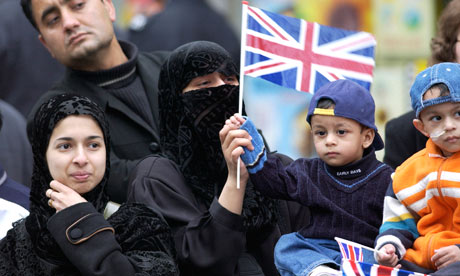
News: Muslims in UK and loyalty

Muslims proud to be British? There's something to learn from the surprise
Bemusement at the findings of Muslim pride in Britain stems from stereotyping about religious groups 
Wednesday 23 November 2011

    Crowds in London with Union flags welcome the Queen on her jubilee tour in 2007. Illustration: Tim Graham/Getty Images
    The finding in Demos's report A Place for Pride that 83% of Muslims said they were proud to be a British citizen, compared with the national average of 79%, has been met with surprise in some parts of the press. Clearly many British citizens have both a strong religious identity and a strong national identity. Yet it also seems clear that many people see these identities as mutually exclusive. Why is this the case?
    That 83% of Muslims are proud to be British does in fact make sense. Many British Muslims come from families that have sought the opportunity and refuge offered in this country. The Demos report suggests that "People who are religious are more likely to be patriotic than are those who self-define as atheists or nonbelievers"; 88% of Anglicans and Jews agreed that they were "proud to be a British citizen". Many British Jews have a family history of refugee status and it follows that this leads to a sense of pride in their British identity. People with a strong religious identity are also often part of a strong community, and benefit from the co-operation and collective goodwill that can come with this. Patriotism, the report suggests, isn't only concerned with Queen and flag, but also with community values.
    There is a lot of misinformation about the British Muslim community. In 2009 the Gallup Coexist Index found that only 36% of the British public thought that British Muslims were "loyal to this country" as opposed to 82% of the British Muslim community. The surprise at the findings of Muslim pride in Britain is rooted in a prejudice that leads people to believe that it is paradoxical for someone to hold both their religious and national identities as important. Lazy caricatures of Islam as contradicting many of the rights and values that are seen as quintessentially British – particularly freedom and democracy – only exacerbate this problem.
    So, how do we tackle the prejudice that leads to this view? We must start by challenging perceptions of faith groups that rely on broad stereotypes, and instead provide people with opportunities for meaningful engagement, where they can meet and learn about each other as individuals. The report quotes a student who participated in Three Faiths Forum's Undergraduate ParliaMentors programme, which gives young people the opportunity to work with students of different faiths and non-religious beliefs on social action projects, and to be mentored by MPs and peers.
    The "people I worked with, neither of them had even met a Jewish person before. I found it quite daunting but it was good and it helped me in a way to understand who I am as well as to know more about Islam and Christianity. In the end, the things we sometimes fell out about were what we were doing on the project – not God."
    Finding out that the difficulties that come with working with others are often simply the usual interpersonal challenges is an important part of seeing others as individuals, not just a Muslim, Jew, atheist etc.
    What we need are more opportunities for this humanising process. If we can find these while people work together on a social cause then this is all to the good. One of the clear implications of the Demos research is that public pride is linked closely with "social engagement, interpersonal trust and volunteerism". If we embrace opportunities to work with people of all faiths and beliefs then we can start to overcome the prejudice that leads to surprise that other people are also proud of Britain. We will, in turn, also give ourselves more reasons for civic pride.

Quiz in 2 weeks...(I/A)
Last Quiz was on 9th September 2011 ~ So revise everything since then, including:

Seerah
Banu Quraizah
Abu Lubabah
The Prophet offers to marry Rehana, a Jewish captive
Lessons from Ghazwah al-Ahzab (Battle of Khandaq – Ditch or Confederates/Coalition)
Banu Quraizah
Saad bin Muadh passes away
Some virtues of Saad ibn Muadh
Banu Mustaliq and Abdullah ibn Ubai (Leader of the Hypocrites)
Tribalism (nationalism) leading to the argument and in-fighting
Tayammum (ablution without using water)
Prophet* marries Juwairiyah
The incident of the Ifk (Slander) against Aisha.
Selected Verses Surah an-Nur (24: 11-25)
Lessons from The Ifk (lie) against Aisha
The Death of Abu Rafi’
Bani Bakr Expedition
Other Expeditions and Delegations (including: Bani Asad; Bani Tha‘labah in Dhil Qassa; Abu ‘Ubaidah bin Al-Jarrah; Bani Saleem; Zaid bin Haritha in Al-‘Ais; Bani Tha‘labah; Wadi Al-Qura)
Zainab’s (the Prophet’s daughter)
The Prophet* Marries Zainab with Zaid
The Prophet* Marries Zainab
Clarification of Adoption
Uraynah Robbers
Story of Salamah ibn Akwa

Hadith: Nawawi’s 40 Hadith (nos 31 - 34)
Hadith no 31 (Loved Actions): On the authority of Abu al-Abbas Sahl bin Sa'd al-Sa'idi who said: A man came to the Prophet*, and said: "O Messenger of Allah, direct me to an act which if I do it, [will cause] Allah to love me and people to love me." He*, answered: "Be indifferent to the world and Allah will love you; be indifferent to what people possess and they will love you." [Ibn Majah]
Hadith 32 (No Harming nor Reciprocating Harm): It was related on the authority of Abu Sa'id Sa'd bin Malik bin Sinan al-Khudri, that the Messenger of Allah*, said:  "There should be neither harming [darar] nor reciprocating harm [diraar]" [Ibn Majah, Al-Daraqutni and others]
Hadith 33: (Onus of Proof is on the Claimant): Ibn 'Abbas said that the Messenger of Allah*, said: "Were people to be given according to their claims, some would claim the wealth and blood of others. But the burden of proof is upon the claimant and the taking of an oath is upon the one who denies (the allegation)." [al-Bayhaqi, al-Bukhari and Muslim]
Hadith 34 (Changing an Evil): On the authority of Abu Sa'id al-Khudri who said: I heard the Messenger of Allah*, say: "When any one of you sees anything that is disapproved (of by Allah), let him change it with his hand. If he is not able to do so, then let him change it with his tongue. And if he is not able to do so, then let him change it with his heart, though that is the weakest (kind of) faith." [Muslim]

Main Topics (or other discussions)
Al Qadha Wal-Qadr (Divine fate & Destiny)
The Greatness of first 10 days Dhul-Hijjah
Highlights from the Life of Ibrahim [Abraham]
Selected Qualities of Ibrahim
Eid-ul Adha
Prophets on the different levels of Heaven
Tips on how to maintain prayers in school

News Topics
Falling satellites
Pakistan Floods
Palestine's Statehood bid and the US/UN
Assassination of Imam Anwar al-Awlaki
Vandalism of Graves in Israel/Palestine
Two Muslim children who are young and finished A-Levels
What is ‘intelligence’ and who are clever.
The difference between Proof and Evidence.
The Death of Gaddafi
Death in King's Heath of a young girl on a bike
Muslims in UK and loyalty

Feedback
Exams (lessons from Quiz / Questionnaires)
Scary Words (or Concepts)
Taqdeer (al-Qadha wal-Qadr)
Different colours
Prayer
Mosque
Islamic Calendar
Some Etiquettes of Visiting the Graves
Allah: 10 things about Allah that we need to know
Jannah-Jahannum:  Paradise and Hellfire
The Last Day
Signs of ad-Dajjal
The Day of Judgement
Unity of the Muslims - what this means
The Life of the Prophet
The M5 crash
Juj & Majooj
Equality for Muslims