20 November 2011
Salamah bin Al-Akwa and Changing Evil by the Hand
Seerah of Muhammed*
*: May the Peace, Blessings and Mercy of Allah be upon him
TMQ: Translation to the nearest meaning of the Qur’an
The Story of Salamah bin Al-Akwa (Dhu Qarad Invasion)
It has been narrated on the authority of Salamah bin
Al-Akwa‘, the hero of this battle, that the Messenger of Allah* sent his
hireling Rabah, with his camels to a nearby pasture. I, taking Talhah’s horse,
went there for the same purpose. When the day dawned, ‘Abdur Rahman Al-Fazari
made a raid, drove away all the camels, and killed the man who looked after
them. I told Rabah to ride the horse, take it to Talhah and inform the
Messenger of Allah* that the polytheists had made away with his camels. Then I
stood upon a hillock and turning my face to Medina, shouted thrice: "Come
to our help!" After that I set out in pursuit of the raiders, shooting at
them with arrows and chanting (self-eulogatory) verse: "I am the son of
Al-Akwa‘, Today is the day of defeat for the mean."
By Allah, I continued shooting at them and hamstringing
their animals. Whenever a horseman turned upon me, I would come to a tree (hid
myself) sitting at its base, shoot at him and hamstring his horse. At last they
entered a narrow mountain gorge.
I ascended that mountain and held them at bay throwing
stones at them. I continued to chase them in this way until I got all the
camels released with no one left with them. They fled in all directions and I
following and shooting at them continually until they dropped more than thirty
mantles and thirty lances, lightening their burden. On everything they dropped,
I put a mark with a stone so that the Messenger of Allah* and his Companions
might recognize them (that it was booty left by the enemy). They went on until
they came to a narrow valley. They sat down to eat something, and I sat on the
top of a tapering rock. Four of them ascended the mountain coming towards me
after Uyanah told them to give chase to me. When they were near enough to hear
me, I shouted: "Do you recognize me?" They said: "No. Who are
you?" I said: "I am Salamah son of Al- Akwa‘. I can kill anyone of
you I like but none of you can kill me."
So they returned. I did not move from my place until I saw
the horsemen of the Messenger of Allah*, who came riding through the trees. The
foremost among them was Akhram, behind him was Abu Qatadah Al-Ansari followed
by Al-Miqdad bin Al-Aswad. Akhram and ‘Abdur Rahman Al-Fazari met in combat.
Akhram hamstrung ‘Abdur Rahman’s horse but the latter managed to strike him
with his lance and kill him. ‘Abdur Rahman turned around riding Akhram’s horse.
Abu Qatadah, seeing this, got engaged in fierce combat with ‘Abdur Rahman,
smote him with his lance and it was fatal. The polytheists consequently fled away
and I was in their pursuit until before sunset they reached a valley with a
spring of water called Dhu Qarad. They rested there to have a drink. I however,
running in hot pursuit, turned them out of the valley before they could drink a
drop of water. Later on, the Prophet*, along with his Companions, overtook me.
I addressed him saying: Messenger of Allah, let me select from our people one
hundred men and I will follow the marauders and finish them. In reply, the
Prophet* said: "Ibn Al-Akwa‘, you have taken enough and so now you have to
show magnanimity; now they have reached the habitation of Ghatfan where they
are being feted." He added saying: "Our best horseman today is Abu
Qatadah, and our best footman today is Salamah."
He allotted me two shares of the booty - the share meant for
the horseman and the other meant for the footman, and combined both of them for
me. Intending to return to Medina, he made me mount behind him on his she-camel
called Al-Adba.
Also it is stated that as they reached the outskirts of
Medina, a man from the Ansar was boasting (in a joking fashion) that he was the
fastest runner and no-one could beat him. So Salamah asked the Prophet*'s
permission and ran with him - giving him a headstart. As they were about to
enter Medina Salamah slapped the other man between the shoulder blades and said
that he was the fastest. Indeed you are was the reply.
Hadith: Nawawi’s 40 Hadith
Hadith 34: Hadith on Changing the Evil
On the authority of Abu Sa'id al-Khudri who said: I heard
the Messenger of Allah*, say: "When any one of you sees anything that is
disapproved (of by Allah), let him change it with his hand. If he is not able
to do so, then let him change it with his tongue. And if he is not able to do
so, then let him change it with his heart, though that is the weakest (kind of)
faith." [Muslim]
Essence of Dawa
The essence of the Islamic da'wah is enjoining the good and
forbidding the evil, since whenever a person conveys the Message, he is
enjoining good and forbidding evil. Therefore, it is a mistake to consider
these two as separate matters, since they are actually performed concurrently
and are synonymous. The main objective in fulfilling this obligation is to
attain and maximize benefits, and to eliminate or minimize harm.
Munkar (evil) is everything denounced and prohibited by Shar'a,
like neglecting an obligation or committing haram. Forbidding munkar is a
divine law (Hukm Shar'ai) prescribed by Allah the Supreme upon all Muslims,
whether they are individuals, groups, parties, nation and State.
Allah the Supreme made it obligatory upon Muslims to
establish from themselves parties and groups in order to enjoin the right
conduct and forbid indecency. Allah said, "Let spring from you a nation
who invite to goodness, and enjoin right conduct and forbid indecency. Such are
they who are successful".
Allah has honoured this nation by making her the best nation
that was raised up for mankind as she enjoins the right conduct and forbids
indecency, and believes in Allah. He said, "You are the best nation that
hath been raised up for mankind. You enjoin right conduct and forbid indecency,
and you believe in Allah".
Allah has differentiated between the believers and the
hypocrites on the basis of enjoining the good conduct and forbidding indecency.
He said, "The hypocrites, both men and women, proceed one from another.
They enjoin the wrong and they forbid the right (conduct)". And He said,
"And the believers, men and women, are protecting friends one of another;
they enjoin the right conduct and forbid the wrong".
Allah has threatened Muslims by punishment if they remained
silent about the wrong, and they did not act to change it and remove it. It was
narrated about Huthaifa bin Al-Yaman about the Prophet* he said,"(I vow)
by the One in Whose hands my soul rests, you have to enjoin right and forbid
the wrong, other wise Allah will be about to send upon you a punishment from Him,
then you would pray to Him and ask Him but He would not answer you". It
was also narrated about Haitham, he said, "I heard the Prophet* said, 'Any
people amongst whom sins are committed, and they could change them but they did
not (change), Allah will be about to bring a general (prevalent?) punishment
upon them'".
According to what Ahmed narrated, the Prophet* said,
"Allah will not punish the common people because of the action of
particular people, unless (until) they see the wrong among themselves and they
are able to change it but they do not. Once they have done that He would punish
the particular people and the common people”. So any muslim who witnesses a
wrong thing - any wrong thing - in front of him, he has a duty to work for
forbidding it and changing it by one of the three ways mentioned in the
tradition (hadith) by Abu Said Al-Khudri according to his capability, otherwise
he would be sinful.
Enjoining the good and forbidding the wrong
Enjoining the good and forbidding the wrong was practised at
the time of the Prophet (saw), at the time of the companions (sahaba), at the
times of the Followers (At-tabieen) and the Followers (Tab'ee at Tab'een); and
this law will remain until the Day of Judgement. The wrong (Munkar) may occur
by individuals, or groups or by the State. The one who forbids the wrong and
changes it is the state, the individuals and the parties.
Commanding the good and forbidding the evil is a Fard
Kifaayah [Collective Duty], so if a group of people establish it such that they
suffice then the obligation falls from the rest of the people. But if all of
the people leave it, then all of them, who are able to do it without
difficulty, are sinful. Further, sometimes it may be restricted to certain
individuals, such as if it concerns an affair that none knows of other than he,
or none other than he has the ability to stop that affair, such as the one who
sees his wife or son or slave perform an evil. The Prophet (saw) says,
"Imam is a shepherd (caretaker) and he is responsible about his
citizens". Allah delegated him to force people whether individuals or
groups, to perform all the obligations (duties prescribed upon them by Allah.
If the matter requires using the force to compel them to perform these duties,
he is obliged to use it. Allah, also, made it obligatory upon him to prevent
people from committing the prohibited things. And if the matter requires using
the force to prevent them from committing the prohibited things, it is
obligatory upon him to use it. So the state is the origin for changing the
wrong and removing it by hand, i.e. by force, because it is responsible by
Shar'a about application of Islam and compelling them to obey its rules. In
regard with changing the wrong by individuals, the individual who sees a wrong
thing in front of him, such as to see a person who drinks alcohol, or steals or
he is about to kill somebody or to commit adultery with a woman or any other
wrong thing, the it is obligatory upon him to forbid this wrong, and to work
for changing it and removing it; and he would be sinful if he failed to do
that. If he was able even if most likely - to remove this wrong by his hand
then he is obliged to start changing it and removing it. Thus he prevents the
person from drinking alcohol, or from stealing, or from killing or from
adultery. He has to prevent that and remove it by hand, because he is able to
change it by hand, in fulfilment to the saying of the Prophet (saw),
"Whoever of you sees a wrong thing, let him change it by hand (i.e. by
force)".
Allah has said : "The Messenger's duty is only to
convey (the message) in a clear way" [Surah an-Noor, 54]. The scholars
have said: "It is not a condition for the commander of good or the
forbidder of evil to himself be perfect in his condition, and fully complying
with that which he commands and fully leaving that which he forbids. Rather
upon him is to command, even if he himself is not upon that completely. This is
because he has two duties upon him: firstly, to order his own soul upon good
and forbid it from evil, and secondly to command and forbid other people. So if
he fulfils one of them then the other still remains obligatory upon him."
Using the hand, i.e. the physical power to change the wrong
depends on the actual capability
Using the hand, i.e. the physical power to change the wrong
depends on the actual capability - even if it is most likely - to change this
wrong and to remove it by hand. If there was no ability to remove it, then the
hand has not to be used, because using it as such would not achieve the aim it
is used for, which is changing the wrong and removing it. So the place of using
the hand, as mentioned in the hadith (tradition) depends on the ability to
change the wrong actually. The evidence of this is that the hadith (tradition)
make a transfer to forbidding the wrong by tongue (words) in case of the
inability, i.e. in case of the inability to forbid the wrong and remove it by
hand; where it said, "If he could not then let him forbid it by his
tongue". Forbidding the wrong by tongue is not considered a changing of
the wrong, it is rather a charging against the one who commits the wrong, i.e. denouncing
his committing of the wrong. If he could not denounce by his tongue, then he
has to hate that wrong by his heart and not to accept it.
And his* statement "let him change it with his hand;
and if he is not able to do so, then [let him change it] with his tongue; and
if he is not able to do so, then with his heart" means that he must hate
it with his heart, and this does not stop the evil occurring nor change it to
something good, but this is all that he is capable of doing.
And his* statement "and that is the weakest of
faith" means, and Allah knows best, that this is the smallest possible
fruit or result of his faith. And it is not upon the one who commands the good
and forbids the evil to investigate and search and spy upon others, or to
invade others privacy or to suspect others in order to find their wrongs.
Rather, if he comes upon an evil then he changes it. And as for his (SAW)
statement "and that is the weakest of faith" then it has already been
mentioned that this means the smallest fruit of one’s faith.
Mandatory on Muslims
Sometimes when Muslims engage themselves in debate with
journalists and media outlets, the conversation ends with the Muslims being told
that the only reason they are able to speak is because of the ‘freedom of
speech’ they are entitled to in democracies and that this is the reason they
can be critical and disagree with others in the west. This argument is based
upon a premise which assumes that the reason Muslims speak out against the
injustices which they see around the world is because they have the ‘freedom’
to do so and for this reason Muslims should be grateful. This could not be
further from the truth! The fact of the matter is that even before the birth of
the concept of ‘free speech’ in Europe and America, Allah had revealed to the
Muslims the concept of enjoining the good and forbidding the evil, as explained
above. This is more precious and worthwhile than ‘free speech’, not only
because it is from Allah, but also because the ‘freedom of speech’ in itself is
merely a choice that an individual can uphold or ignore and we see this
everyday in the streets of western cities.
The concept of enjoining the good and forbidding evil
however is mandatory on Muslims. Hence it creates a proactive mentality where
the Muslims will involve themselves in stopping the injustices and if necessary
in many cases put their own lives at risk for others. Anybody who has been to
the Muslim world would know that when any crime occurs, people from the street
involve themselves to resolve these issues and if necessary stop the injustice,
even if both the perpetrator and victim are complete strangers. For example, we
recently saw the Ummah hold the rulers accountable in Egypt, Jordan, Algeria
and Tunisia for their continuous transgression against the Ummah. Also, during
the Gaza Massacre of 2009, the Ummah in Egypt and elsewhere held the rulers
accountable for allowing Israel to massacre our brothers and sisters in
Palestine. And there have been many individuals and members of groups who have
held their rulers accountable and faced harsh consequences, such as
imprisonment, torture, and even death. These actions carry a high reward based
on the following hadith: “The master of the martyrs is Hamza ibn Abdul
Mattalib, and a man who stands (in front of) an oppressive ruler and enjoins
the good and forbids the evil and so is killed for it.” [Hakim]
Qualities possessed by a Caller who enjoins the good and
forbids the evil
- Ikhlas (Sincerity) - since enjoining the good and forbidding the evil becomes an action pleasing to Allah and accepted by Him only if it is done with sincerity for Him.
- 'Ilm (Knowledge) - as Allah commands: Say: This is my path, I do call to Allah upon clear knowledge. [Surah Yusuf (12): Ayah 108] This is an important condition since the Caller must know what matters are good, so he enjoins it, and what matters are evil, so he forbids it. In Ibn Taymiyyah's al-Amar it is stated that it is necessary to possess the knowledge of good and evil and of the difference between them, and it is necessary to know the situation of the person being commanded or forbidden.
- Hikmah (Wisdom) - which means saying or doing the right thing in the right way at the right time to the right person, as prescribed by Allah in His statement: Call to the way of your Lord with wisdom and beautiful admonition. [Surah an-Nahl (16): Ayah 125] Ibn Taymiyyah wrote: Enjoin the good in a good way and do not forbid the evil in an evil way.
- Hilm (Forbearance) and Rifq (Gentleness) - especially in the face of opposition from the people. As Allah said to His Messenger*: And by the Mercy of Allah you were able to deal gently with them. If you had been severe and harsh-hearted, they would have broken away from you. [Surah al-Imran (3): Ayah 159]. The Prophet*, also said: Indeed gentleness does not enter into anything except it beautifies it, nor is it removed from anything except that it makes it ugly [Muslim].
- Sabr (Patience) - since the people whom the Caller opposes in enjoining good and forbidding evil, may be stubborn to his call and may even try to harm him. Ibn Taymiyyah says in al-Istiqaamah, concerning the call to the good and away from the evil: Knowledge must precede it, gentleness must accompany it and patience must follow it. Scholars say, in an explanation of Surah al-'Asr that Allah makes an oath that mankind will be in a state of deficiency, except with four conditions, which are: (a) iman, (b) good actions, (c) encouraging each other to the truth which means enjoining the good and forbidding the evil, and (d) encouraging each other to patience, which is required after enjoining good and forbidding evil. Furthermore each person will have a level of deficiency in accordance with the level of lack of any of these four.
- Tawaadu' (Humility) - since the people will not heed if the Caller is arrogant or he seeks to put himself above others.
- Qudwah (Good example) - for the Caller himself becomes a model to the people to whom he calls, doing those things which he enjoins and leaving those things which he forbids. Allah says: O you who believe! Why do you say that which you do not do. It is a most hateful thing to Allah that you say that which you do not do. [Surah as-Saff (61): Ayah 2-3]
- Husnul-Istimaa' (Good listening) - which is that the Caller is attentive to the needs and feelings and also the complaints of the people whom he calls.
- Shajaa'ah (Courage) - which does not refer to strength of the body; rather it is the strength of the heart, together with knowledge - this differentiates between true courage and mere recklessness.
- Karam (Generosity).
Some Principles of Inkaarul-Munkar (Forbidding what is evil)
1. Do not look for people's faults.
2. Establish that the evil is indeed taking place.
3. Choose a suitable time to forbid the evil.
- The Caller (Dai'i) should not delay until the evil has finished.
- The Caller should exploit situations in which the people are more likely to respond to his call, for example when Prophet Yusuf spoke to his companions in the prison about tawhid when they had been troubled by their dreams. Ibn Masoud said concerning this: Verily the heart has moments of yearning and responsiveness and moments of indifference and turning away, so snatch it at the time of yearning and response and leave it at the time of indifference and turning away.
4. Speak in private, as Imam ash-Shafie wrote: Come to me
with your advice when I am alone and do not advise me in the crowd because
advice amongst the people is a scolding and I do not like to hear it aloud. Then
if you disobey me and do not heed my words do not feel sad when you are not
followed. He also said: "He who admonishes his brother in secret has
sincerely advised him and has adorned him, while he who admonishes his brother
openly [in front of everyone] has humiliated him and disfigured him."
5. Do not instigate or provoke the people, but use a good
argument, as Allah says: Call to the way of your Lord with wisdom and beautiful
admonition, and argue with them with ways that are best. [Surah an-Nahl (16): Ayah 125]
6. Show forgiveness and kindness towards the people, and not
to be affected by worry or anger in case the people show a negative response to
the advice.
7. If a difference of opinion arose as a result of ijtihaad,
then the Caller who holds one opinion should not forbid the other opinion.
Feedback
Equality - how Muslims are equal and how we should treat
each other, as well as non-Muslims
Tips on how to pray during school hours
We discussed how children could make sure they don't miss
their prayers in school, especially in the winter months when the prayers are
close together.
Tips include:
- Have wudu when leaving for school in the morning
- Practice masahah (wiping the tops of the socks)
- Not drinking too much
- Praying seated down
- If you are not sure about the direction just guess
- Asking for a Prayer Room
- Look for other places to pray
- Make sure you always pray with someone else (you can remind each other)
- Some people combine prayers (Dhuhr ans Asr)
- Praying with your fingers
- Just praying the Fard
News: Muslims in UK and loyalty
Muslims proud to be British? There's something to learn from the surprise
Bemusement at the findings of Muslim pride in Britain stems from stereotyping about religious groups
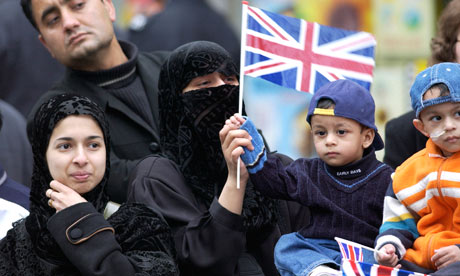
Wednesday 23 November 2011
Crowds in London with Union flags welcome the Queen on her jubilee tour in 2007. Illustration: Tim Graham/Getty Images
The finding in Demos's report A Place for Pride that 83% of Muslims said they were proud to be a British citizen, compared with the national average of 79%, has been met with surprise in some parts of the press.
Clearly many British citizens have both a strong religious identity and
a strong national identity. Yet it also seems clear that many people
see these identities as mutually exclusive. Why is this the case?
That
83% of Muslims are proud to be British does in fact make sense. Many
British Muslims come from families that have sought the opportunity and
refuge offered in this country. The Demos report suggests that "People
who are religious are more likely to be patriotic than are those who
self-define as atheists or nonbelievers"; 88% of Anglicans and Jews
agreed that they were "proud to be a British citizen". Many British Jews
have a family history of refugee status and it follows that this leads
to a sense of pride in their British identity. People with a strong
religious identity are also often part of a strong community, and
benefit from the co-operation and collective goodwill that can come with
this. Patriotism, the report suggests, isn't only concerned with Queen
and flag, but also with community values.
There is a lot of misinformation about the British Muslim community. In 2009 the Gallup Coexist Index
found that only 36% of the British public thought that British Muslims
were "loyal to this country" as opposed to 82% of the British Muslim
community. The surprise at the findings of Muslim pride in Britain is
rooted in a prejudice that leads people to believe that it is
paradoxical for someone to hold both their religious and national
identities as important. Lazy caricatures of Islam as contradicting many
of the rights and values that are seen as quintessentially British –
particularly freedom and democracy – only exacerbate this problem.
So,
how do we tackle the prejudice that leads to this view? We must start
by challenging perceptions of faith groups that rely on broad
stereotypes, and instead provide people with opportunities for
meaningful engagement, where they can meet and learn about each other as
individuals. The report quotes a student who participated in Three
Faiths Forum's Undergraduate ParliaMentors
programme, which gives young people the opportunity to work with
students of different faiths and non-religious beliefs on social action
projects, and to be mentored by MPs and peers.
The "people I
worked with, neither of them had even met a Jewish person before. I
found it quite daunting but it was good and it helped me in a way to
understand who I am as well as to know more about Islam and
Christianity. In the end, the things we sometimes fell out about were
what we were doing on the project – not God."
Finding out that the
difficulties that come with working with others are often simply the
usual interpersonal challenges is an important part of seeing others as
individuals, not just a Muslim, Jew, atheist etc.
What we need are
more opportunities for this humanising process. If we can find these
while people work together on a social cause then this is all to the
good. One of the clear implications of the Demos research is that public
pride is linked closely with "social engagement, interpersonal trust
and volunteerism". If we embrace opportunities to work with people of
all faiths and beliefs then we can start to overcome the prejudice that
leads to surprise that other people are also proud of Britain. We will,
in turn, also give ourselves more reasons for civic pride.
Quiz in 2 weeks...(I/A)
Last Quiz was on 9th September 2011 ~ So revise everything since then, including:Seerah
Banu Quraizah
Abu Lubabah
The Prophet offers to marry Rehana, a Jewish captive
Lessons from Ghazwah al-Ahzab (Battle of Khandaq – Ditch or Confederates/Coalition)
Banu Quraizah
Saad bin Muadh passes away
Some virtues of Saad ibn Muadh
Banu Mustaliq and Abdullah ibn Ubai (Leader of the Hypocrites)
Tribalism (nationalism) leading to the argument and in-fighting
Tayammum (ablution without using water)
Prophet* marries Juwairiyah
The incident of the Ifk (Slander) against Aisha.
Selected Verses Surah an-Nur (24: 11-25)
Lessons from The Ifk (lie) against Aisha
The Death of Abu Rafi’
Bani Bakr Expedition
Other Expeditions and Delegations (including: Bani Asad; Bani Tha‘labah in Dhil Qassa; Abu ‘Ubaidah bin Al-Jarrah; Bani Saleem; Zaid bin Haritha in Al-‘Ais; Bani Tha‘labah; Wadi Al-Qura)
Zainab’s (the Prophet’s daughter)
The Prophet* Marries Zainab with Zaid
The Prophet* Marries Zainab
Clarification of Adoption
Uraynah Robbers
Story of Salamah ibn Akwa
Hadith: Nawawi’s 40 Hadith (nos 31 - 34)
Hadith no 31 (Loved Actions): On the authority of Abu al-Abbas Sahl bin Sa'd al-Sa'idi who said: A man came to the Prophet*, and said: "O Messenger of Allah, direct me to an act which if I do it, [will cause] Allah to love me and people to love me." He*, answered: "Be indifferent to the world and Allah will love you; be indifferent to what people possess and they will love you." [Ibn Majah]
Hadith 32 (No Harming nor Reciprocating Harm): It was related on the authority of Abu Sa'id Sa'd bin Malik bin Sinan al-Khudri, that the Messenger of Allah*, said: "There should be neither harming [darar] nor reciprocating harm [diraar]" [Ibn Majah, Al-Daraqutni and others]
Hadith 33: (Onus of Proof is on the Claimant): Ibn 'Abbas said that the Messenger of Allah*, said: "Were people to be given according to their claims, some would claim the wealth and blood of others. But the burden of proof is upon the claimant and the taking of an oath is upon the one who denies (the allegation)." [al-Bayhaqi, al-Bukhari and Muslim]
Hadith 34 (Changing an Evil): On the authority of Abu Sa'id al-Khudri who said: I heard the Messenger of Allah*, say: "When any one of you sees anything that is disapproved (of by Allah), let him change it with his hand. If he is not able to do so, then let him change it with his tongue. And if he is not able to do so, then let him change it with his heart, though that is the weakest (kind of) faith." [Muslim]
Main Topics (or other discussions)
Al Qadha Wal-Qadr (Divine fate & Destiny)
The Greatness of first 10 days Dhul-Hijjah
Highlights from the Life of Ibrahim [Abraham]
Selected Qualities of Ibrahim
Eid-ul Adha
Prophets on the different levels of Heaven
Tips on how to maintain prayers in school
News Topics
Falling satellites
Pakistan Floods
Palestine's Statehood bid and the US/UN
Assassination of Imam Anwar al-Awlaki
Vandalism of Graves in Israel/Palestine
Two Muslim children who are young and finished A-Levels
What is ‘intelligence’ and who are clever.
The difference between Proof and Evidence.
The Death of Gaddafi
Death in King's Heath of a young girl on a bike
Muslims in UK and loyalty
Feedback
Exams (lessons from Quiz / Questionnaires)
Scary Words (or Concepts)
Taqdeer (al-Qadha wal-Qadr)
Different colours
Prayer
Mosque
Islamic Calendar
Some Etiquettes of Visiting the Graves
Allah: 10 things about Allah that we need to know
Jannah-Jahannum: Paradise and Hellfire
The Last Day
Signs of ad-Dajjal
The Day of Judgement
Unity of the Muslims - what this means
The Life of the Prophet
The M5 crash
Juj & Majooj
Equality for Muslims

