Monday, 11 February 2013

10 January 2013


Summary
Lives of the Prophets:
We study the Lives of the Prophets because:
- Allah commanded the Prophet* to tell these stories
- So we can reflect on these
- We should follow their advice (as role models)
- So we learn to love them
Nabi (plural Ambiya) are Prophets from Allah (124,000)
Rasool (plural Musul) are special Prophets that have also been given a Law for people to follow
Everything was written down by Allah 50,000 years before the creation of the Heavens and Earth

Main Topic: Short video reminder on Surah al-Asr
Allah says:
- Time is Running Out
- Man is in Drowned in Deep Loss
- Except:
- Those who Believe
- (that they are in Loss, hence they try to reconcile the situation by swimming = DOING GOOD DEEDS to correct the situation)
- And Tell Others the Truth (over and over again)
- And keep Persistently doing these with Patience (Sabr)
Hence all 4 conditions required to SURVIVE!


LOGO
Don’t forget to design a LOGO for the Harborne Islamic Study Circle
Something that will go on all handouts and the website….Get designing.
Winning entries to be chosen by the group!!


Lives of the Prophets:
Lives of the Prophets: Introduction
Why should we talk about the Lives of the Prophets? It’s not just history….Benefits of Talking about the Prophets include:
1. Because Prophet Muhammed*  was commanded to do so. Allah says “relate unto them the stories.” This is a command from Allah to the Prophet*. It becomes a duty upon us to convey the message of the Prophets of Allah and their stories. So this is first an ‘ibaadah – a worship.
2. “Relate and convey to them so that they may reflect.” (TMQ 7:176) These stories are not for entertainment; they are to derive lessons, deeply reflect and contemplate. At the time of the Prophet* the Quraish would try to distract the people with other ‘stories’ from Persia. These stories do not have the details you will find in JKRowling or Tolkien books!
3. Allah says: “They are those whom Allah had guided. So follow their guidance.” (TMQ 6:90) Allah is instructing the Prophet*. It is very important to have role models. You find that every human being has role models. If they aren’t good, they are going to be bad. It is our make up as human beings – we have to have people that we look up to. If we don’t provide our children and youth with the role models of the sahabah and Prophets, they will find role models somewhere else. If Allah is telling the Prophet* to follow the example of the Prophets, then what about us? We need to study the lives of the Prophets so that they become our role models.
4. To love them – if you do not know someone, you cannot love them. We all claim that we love the Prophets of Allah. If we do not know them, what they went through, how could we have respect for them?


Terminology: Nabi (Prophet) vs. Rasool (Messenger)
Abu Dharr came to the Prophet* and asked him, “What is the total number of Prophets?” The Prophet* said, “The number of ambiya (Prophets) is 124,000 and the Rusul (Messengers) among them are 315.” We are translating Nabiy as Prophet and Rasool as Messenger.
They are two different things: nabiy and rasool. The plural of nabiy is ambiya. The plural of rasool is rusul.
So what is the difference between the Prophet (nabiy) and Messenger (rasool)? There are a few opinions about this: the rasool is the nabiy that is given a law. But the nabiy, who is not a rasool, is following the law of another rasool. So every rasool is a nabiy, but not every nabiy is a rasool.
If a Prophet is given a new law, he is a rasool and a nabiy. If he is not given a new law, he is just a nabiy. An example of this: Musa (Moses) is a Rasool – a Prophet – because he was given the Taurah. Haroon is just a Nabi, because he is following the law of his brother.
 

The Story of Creation
Before we start talking about Adam, let’s look at the story of creation. Narrated in Bukhari, ‘Imran ibn Hussain said, people from Yemen came to the Prophet* and said, “We have come to you to learn our religion and ask how all of this started.” The Prophet* said, “There was Allah, and nothing before Him and His Throne was on water. And He wrote everything in the tablet, and He created the heavens and the earth.” [Also see Bukhaari, 9/93/514]  The Prophet* says, “The first thing Allah created was the pen, then Allah ordered it to write. So it wrote everything that will happen until the day of judgment.”
We worry about our rizq – our sustenance. We have a problem of paranoia of rizq. We are always in a state of despair, when it comes to wealth. The Prophet* says, in a hadith narrated by Muslim, “Allah wrote down the sustenance of the creation 50,000 years before He created the heavens and the earth.” Everything that you will get is already written down – not 50,000 year before this day – but 50,000 years before the creation of the heavens and the earth. What you will get is already written down as well as how long you will live.
Time, after all, is your currency of life and we need to spend it wisely. Hence, we will have a reminder about Surah al-Asr…


Surah al-Asr (Reminder Video) by Nouman Ali Khan

(click on the link below or click HERE)


Highlights from the short clip:
You are Drowning and you are Unconscious
Time is running out
Asr literally means time that is running out last part of the day when the day is running out , or like when juice they squeezed out  - time that's being squeezed out like a cloth drenched in water and to squeeze it out.
4 parts to Survival:
1. What do you need to do to survive = WAKE UP. (Even if your having a great dream!)
If you go back to sleep you would be insane! Only blame yourself!
2. Hence – you would SWIM (or try to!)
Pulled back down by a sleeping cousin chained to you!
You try to wake him up (for yourself) but he wants to stay asleep. So both try to swim…
3. TELL OTHERS THE TRUTH
4. Have Patience and Persevere
Allah says:
-       Time is Running Out
-       Man is in Drowned in Deep Loss
-       Except:
-       Those who Believe
-       (that they are in Loss, hence they try to reconcile the situation by swimming = DOING GOOD DEEDS to correct the situation)
-       And Tell Others the Truth (over and over again)
-       And keep Persistently doing these with Patience (Sabr)
Hence all 4 conditions required to SURVIVE!


Children's Feedback

How to start doing Dawah
Study Circle history
What I have leaned from the Study Circle
Hoe the Study Circle has helped me

Information about the London Trip to British Library Mughal Exhibition


Link to the Exhibition - click HERE


Also, we are looking for interest in this Spring’s Study Circle trip. It has been suggested we go to London again for a short exhibition on Mughal India at the British Library.


This is titled ‘Mughal India: Art, Culture and Empire’ and the Exhibition runs until 2 April 2013. We would like, if possible, to take a coach with children & adults to London for the day where we would see the Library Exhibition in the morning, have lunch or a picnic, then do some other activity before returning to Birmingham in the evening. For last year’s trip see the photos on the following link: http://www.facebook.com/media/set/?set=a.10150650782640938.388706.666745937&type=1&l=5e6185db67

Prices = Adults £9; Under 18s FREE; Over 60s £7; Students £5

We haven’t booked the coach but that could cost about £10-£15 per person.

If you are interested – please:

  1. Check the British Library website to more information (http://www.bl.uk/mughalindia/). The exhibition usually takes 2 hours or so.
  2. Also, let us know if you want to take your own sandwiches/picnic or would prefer us to organise catering for food.
  3. Tell us what dates you would like to go: Saturday Saturday 23 March
  4. Finally, suggestions for what to do / where to go after lunch. Such as Kew Gardens, or a local mosque or other attraction...

An example of the exhibits: http://www.bl.uk/whatson/exhibitions/mughalindia/zoomifycrown.html 
 

Homework:
- Lives of the Prophets: What was Adam made from? What are the different terms used in the Quran to describe what Adam (mankind) is made from? 
- Any questions on Evolution?

Wednesday, 6 February 2013

3 February 2013

Special Study Circle: Food and Guest Speaker

To be updated soon (with pictures), I/A 


Speaker Details:
(Who kindly filled in at extremely short notice)
Kamran Hussain 
A family man with a loving wife and 4 beautiful children (MA) who has spent time learning about Islam since his early twenties, which included living in Qatar until 5 years ago. He is currently the regular Khatib for the National Grid and works as a Manager of Strategy and Systems Planning. In addition, Kamran is a Trustee of iERA (Islamic Education and Research Academy) and previously edited the Jumuah Magazine.

Hadith:
Abu Sa`id Al-Khudri (May Allah be pleased with him) reported: Prophet of Allah (sallallahu alayhi wassallam) said: "There was a man from among a nation before you who killed ninety-nine people and then made an inquiry about the most learned person on the earth. He was directed to a monk. He came to him and told him that he had killed ninety-nine people and asked him if there was any chance for his repentance to be accepted. He replied in the negative and the man killed him also completing one hundred. He then asked about the most learned man in the earth. He was directed to a scholar. He told him that he had killed one hundred people and asked him if there was any chance for his repentance to be accepted. He replied in the affirmative and asked, `Who stands between you and repentance? Go to such and such land; there (you will find) people devoted to prayer and worship of Allah, join them in worship, and do not come back to your land because it is an evil place.' So he went away and hardly had he covered half the distance when death overtook him; and there was a dispute between the angels of mercy and the angels of torment. The angels of mercy pleaded, 'This man has come with a repenting heart to Allah,' and the angels of punishment argued, 'He never did a virtuous deed in his life.' Then there appeared another angel in the form of a human being and the contending angels agreed to make him arbiter between them. He said, `Measure the distance between the two lands. He will be considered belonging to the land to which he is nearer.' They measured and found him closer to the land (land of piety) where he intended to go, and so the angels of mercy collected his soul".
[Al-Bukhari and Muslim]

In another version: "He was found to be nearer to the locality of the pious by a cubit and was thus included among them". Another version says: "Allah commanded (the land which he wanted to leave) to move away and commanded the other land (his destination) to draw nearer and then He said: 'Now measure the distance between them.' It was found that he was nearer to his goal by a hand's span and was thus forgiven". It is also narrated that he drew closer by a slight movement on his chest.

Commentary:
1. One comes to know from this Hadith that the gate of Taubah is open even for the worst of the sinners; and Allah forgives everyone provided he repents sincerely, the conditions for such repentance have already been discussed.
2. It is the duty of a religious scholar that while discussing a problem, he should keep in mind the psychological aspects of the questioner and adopt a policy which neither causes a change in the Injunction of Allah nor make the sinner reckless in his sins out of frustration.
3. When a situation warrants, angels appear in the form of men on Orders of Allah.


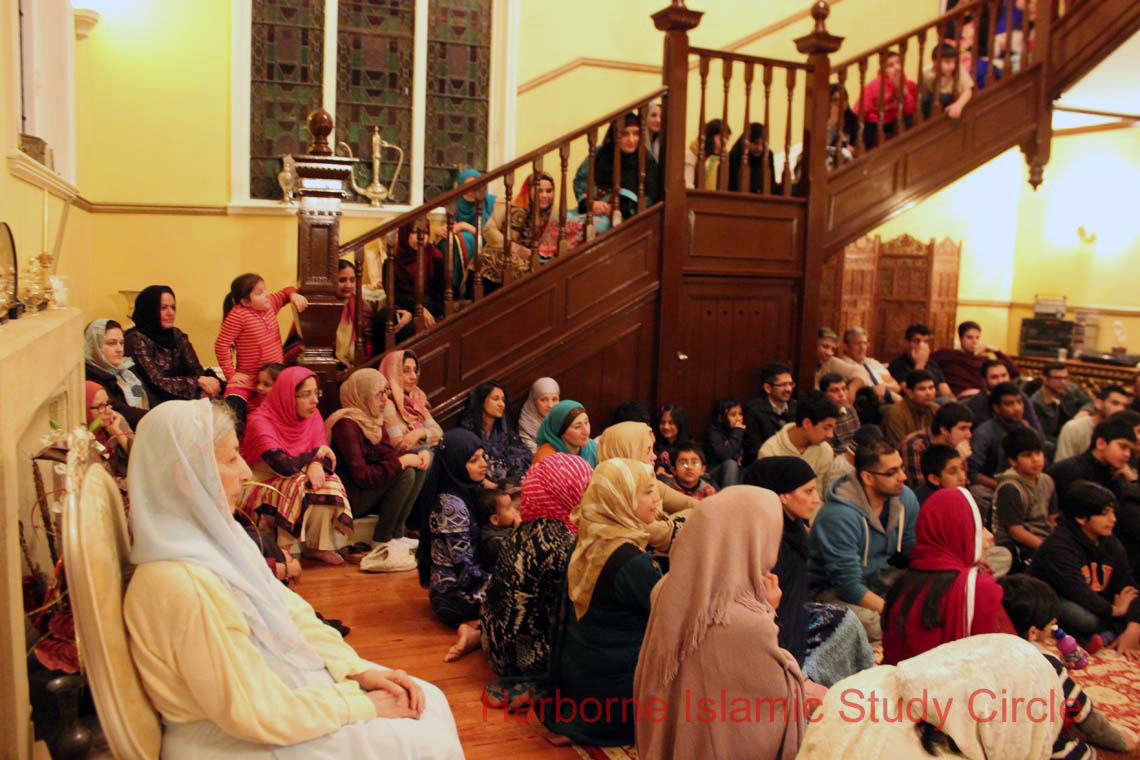
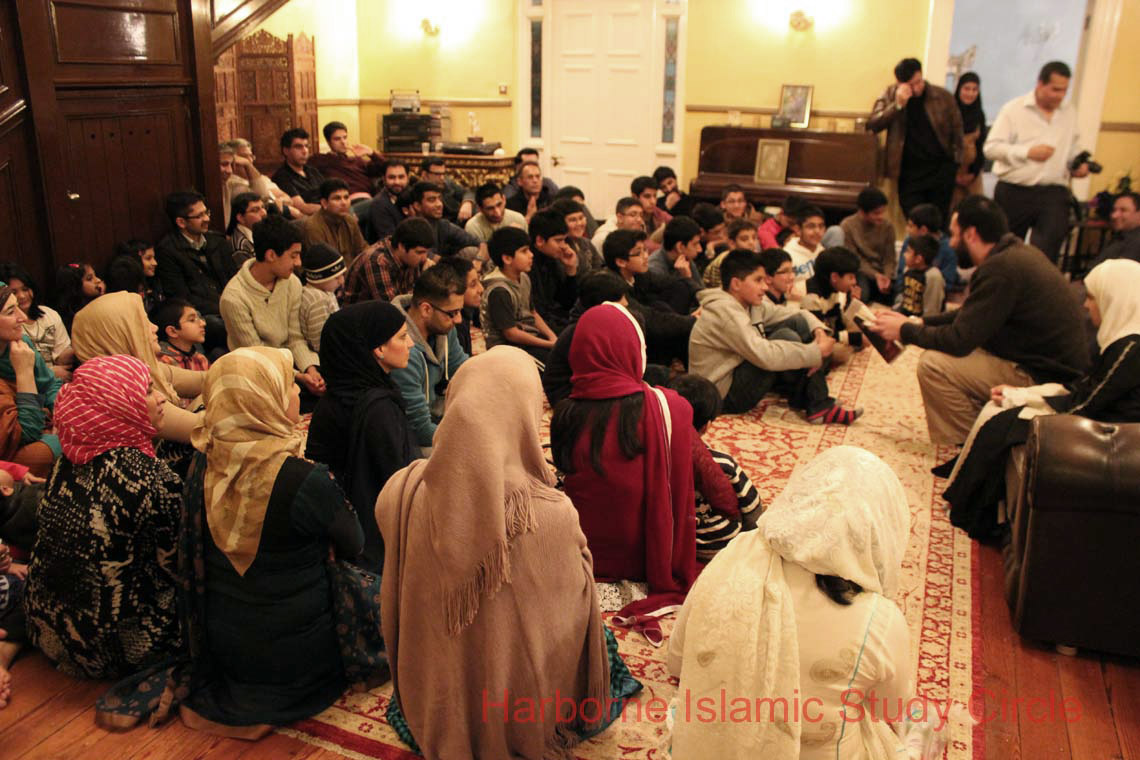
Pictures from the evening


Monday, 28 January 2013

27 January 2012

6th Anniversary of the Harborne IslamicStudy Circle

Full Survey Results

Thank you all for the 52 responses to the online survey.


The results are below:


Hence, by popular demand we hall start to study the Lives of the Prophets (I/A) now that we have chronologically finished the Seerah. That is not to say we know everything about the Prophet*'s life, but are merely acquainted with the major political and social events in his* life. There is, of course, far more to study about the life of the Greatest Man, ever!


By popular demand, we shall keep the Circle to one hour!
However, it is important that people keep to time!!


I have made careful notes on how to improve the Study Circle.I am an constantly seeking to makes things better and to improve the learning experience for people, and welcome all these useful suggestions. InshaAllah, the Circles will be more interactive and inspiring with more quizes and the occasional guest speaker.


It is reassuring that the effort going in to make the handout (and emailed out) is being used by some of you!


It is reassuring that the effort going in to update the blog (website) is being used by some of you!


The respondents were mainly children and teenagers, and more boys than girls...


Time and short Tafsir on Surah al-Asr

Surah al-Asr
The Surah is Makki and it has 3 verses.
With the name of Allah, the All-Merciful, the Very-Gracious
I swear by time,[1] man is in a state of loss indeed,[2]except those who believed and did righteous deeds, and advised each other for truth and advised each other for patience.[3]


Virtues of Studying Surah al-Asr

Ubaidullah ibn Hion reports that whenever two companions of the Holy Prophet met, they would not part company until one of them had recited Surah Al-Asr in its entirety to the other ( transmitted by Al-Tabaarani). Imam Shafi says that if people thought about Surah Al-Asr carefully, it would be enough for their guidance. It is a concise but comprehensive Surah, which in three verses, outlines a complete way of human life based on the Islamic world view.
In the Surah Allah swears an oath by the 'Time" and says that mankind is in a state of loss: exception, however, is made of people ho are characterized by 4 qualities: [1]faith [2]righteous deeds;[3]advising each other for truth and [4] advising each other for patience. this is the only path to salvation in this world, as well as in the next world. The Qur’anic prescription comprises, as we have just seen of four elements. the first two of  them relate to man's own personal betterment and other two relate to other people's guidance and reform [Ibn Kathir]
 

Relationship between 'Time' and 'Human Loss'
The first point that needs to be analysed here is the relationship between the 'oath of time' and 'its subject' because there needs to be a relationship between an 'oath' and 'its subject'. the commentators, generally, state, that all conditions of man, his growth and development, his movements, his actions and morality-all that take place within the space of 'Time'. Man will lose the capital of his existence. Hours, days, months and years of life pass quickly, spiritual and material potentialities, decline, and abilities fade. Man is like a person who possesses great capital and, without his permission and will, every day, a portion of that capital is taken away. This is the nature of life in this word; the nature of continual loss. How well this has been put poetically: "Your life comprises a few breath, that can be counted; when one of them is sent out, a part of your life has diminished."
Allah has granted man the invaluable capital of his life, so that he may invest it in profitable business venture. If he invests his capital of life sensibly in good works, then, let alone attracting profitable returns, he will even lose his capital, and: In addition, he will incur the dreadful scourge of committing numerous sins. If however a person did not invest his life-capital in good deeds or in evil deeds, then he at least, loses both the profit as well as the capital. This is not merely a poetic imagery but is supported by a Prophetic hadith, according to which the Messenger of Allah is reported to have said:
" When a person wakes up in the morning, he invests his soul or life in a business enterprise: some of the investors free or save the capital from loss and others destroy it."
The Quran itself has used the word tijarah in relation to 'faith' and righteous deed' thus: "shall I tell you about a trade that saves you from painful punishment?"( 61:10)
Since “Time" is a man's capital of life, the man himself is a trader. Under normal circumstances, his capital is not a frozen thing that may be kept for a while and used up later when the need arises. The capital is fluid or flowing all the time, every minute and every second. the man who invests it needs to be very wise, intelligent and agile, so that he is able to swiftly and readily reap the profit from a flowing a capital. One of the old scholars said that he had learnt the meaning of this verse from an ice-seller whose trade required utmost diligence, and if he were neglectful for a moment, his entire capital would melt away. that is why this verse has worn an oath by the 'time' to indicate that it is a melting capital and the only loss is to take every moment of his life as valuable, and uses it for the four acts mentioned in the Surah.
Another possible reason for swearing by 'Time' may be that the' time' ( in the sense of history) bears testimony to the fact mentioned in the Surah. If one thinks on the cases of rise and decline of individuals and nations, he would certainly believe that it is only these four acts (mentioned in the forthcoming verses) that may ensure the real success and betterment of mankind. Whoever has ever abandoned them has suffered a great loss, as is evident from numerous events recorded by history.
Let us now study the 'four principles' mentioned  in the Surah. As pointed out earlier, faith and righteous deeds are related to man's moral and spiritual growth and development. They are not in need of elaboration. However, the last two principles (' advising each other for truth') and (advising each other for patience') requires some elaboration.
The infinitive tawasi is derived from wasiyyah, which means 'to advise somebody strongly and effectively about the best thing to do in a particular situation'. The term wassiyyah also refers to a 'will or testament' where a estator advises his executor regarding the disposal of his estate on his death.
The two parts are in fact two chapters of the same testament [1] advice to truth; and [2] advice to patience and fortitude. These two concepts may be explained in different ways. One way to explain them is that haqq ( 'truth') refers to the package of 'correct faith' and ' good deeds' and sabr ( ' patience') refers to abstinence fro all sins and evil deeds. Thus the first cincept refers to 'enjoining good actions' and the second concept refers to 'forbidding evil actions'. The cumulative sense of the Surah is that believers have been enjoined not only to adopt right faith and good deeds themselves, but to advise others strongly and effectively to adopt them and thus help in the creation of a healthy atmosphere around them.
It is also possible to interpret ' Truth' as referring to articles of faith and to interpret 'patience' as referring to all good actions and abstinence from evil deeds. The word sabr, originally meaning to ' withhold oneself and bind oneself', encompasses binding oneself down to the performance of righteous deeds and abstaining from sins.
A scholar has stated in one of the monographs that there are normally two factors that restrain a person from faith and righteous deeds. The first cause is some doubts about the true faith. When such doubts arise in the mind of people, it destroys their faith and leaves them confused and confounded. As a result, it adversely affects their righteous deeds. The second cause is the selfish desires that stop man from doing good and involve him in evil deeds.  In this situation, he theoretically believes that he should do good and abstain from sins, but his selfish desires lead him to stray from the right oath. The current verse indicates to remove both causes of one's distraction. By stressing upon 'advice of truth' it has catered to the first cause and that it should be removed by reforming others on theoretical and academic level, and by emphasizing on ' advice of patience' it has taken care of the second cause by enjoining upon the Muslims to advise others to give up the base desires and remain firm  against their evil demands. Put differently, ' enjoining the truth' means ' improving the knowledge of Muslims or their intellectual development' and enjoining patience' means 'improving the practical life of Muslims'.


Need to Salvage the Entire Muslim Society
The Surah lays down the important principal of guidance for the Muslims that inviting other Muslims to keep to the true faith and good deeds is as much necessary as their own submission to the holy Quran and Sunnah. Without sincere efforts, to the best of one's ability, to invite others to the right path, one's own good deeds are not enough to one's salvation. Especially, if a person does not care of the spiritual and moral welfare of his wife, children and family and turns a blind eye to their unrighteous deeds, he is blocking his way to salvation-no matter how pious he himself might be. Therefore the Quran and Sunnah make it obligatory upon every Muslim to do his best to invite others to the good deeds, and warn them against the evil acts. Unfortunately, let alone the general public, many learned people are lax in this matter. They think it is sufficient for them to be concerned about their own moral and spiritual well-being. They are not concerned about the well-being of their family and children. May Allah grant us the ability to act upon this verse.


Children's Feedback:
6 years of the Study Circle

No Homework

Friday, 25 January 2013

13 January 2013 Quiz 4


Harborne Islamic Study Circle Quiz (4) - Questions


1    Give 1 reason why mothers are so important in Islam [5 marks]
a)   

2    What are the 5 Pillars of Islam [20 marks]
a)   
b)   
c)   
d)   
e)    


3    What are the 6 articles of Belief (Aqeeda) e.g., Belief in ……[24 marks]
a)   
b)   
c)   
d)   
e)   
f)   
 

4    To pass exams you must
a)    Do nothing and hope to pass
b)    Prepare to pass
c)    Trust in yourself

5    Which leader of the Quraish came to Medina to negotiate extending the Treaty of Hudaibiyah
a)    Khalid bin Walid
b)    Abu Sufyan
c)    Abu Lahab

6    How many Hadith are there in Imam Nawawi’s famous book: Nawawi’s 40 Hadith?
a)    40
b)    41
c)    42
 

7    Which Muslim survivor of the Battle of Badr tried to tip the Quraish off about the Invasion of Mecca ?
a)    Muzaynah
b)    Hatib
c)    Abu Ruhm Al- Ghifari

8    What topped the Survey responses about what people want to study in the Study Circle in 2012?
a)    Life of other Prophets
b)    Music and clapping
c)    Celebrating Birthdays

9    Concerning Belief in Allah, can Allah build a wall over which He cannot jump?
a)    Yes – as Allah can do anything
b)    No – because he can’t jump it
c)    It’s a wrong question as we are trying to limit Allah
 

10    The linguistic meaning of the word Shariah is
a)     How to make laws in Islam
b)    Striving with all your effort for the sake of Allah
c)    a non-exhaustive source of water with which people satisfy their thirst.
 

11    List  5 ways of getting to Jannah (paradise) [10 marks]
a)   
b)   
c)   
d)   
e)   

12    Roughly how many Surahs (chapters) of the Qur’an were revealed in Mecca (Meccan Verses)
a)    28
b)    86
c)    114

13    In the Qur’an, sometimes verses revealed later may cancel verses revealed earlier during the life of the Prophet*. This is technically known as
a)    Abrogation
b)    Abdication
c)    Annihilation

14    Fiqh has two meanings: Having the knowledge of the rulings of Shariah (Islamic Law) which are extracted from the legislative sources; or all the Islamic laws. Usul al-Fiqh refers to:
a)    The types of laws in the Shariah
b)    The rules of grammar in the Arabic language that define the meaning of the Ayah or Hadith
c)    the principles by which the scholar derives the legal rules of conduct from the specific evidences

15    When the Prophet conquered Mecca (Fatteh Mecca)
a)    There was widespread bloodshed
b)    The people of Mecca stayed in the hills for 3 days
c)    He entered peacefully thanking Allah

16    When the Prophet conquered Mecca he forgave all the people except a few on a Blacklist. Some of the main reasons for being on the blacklist were:
a)    Insulting the Prophet and leaving Islam
b)    Killing the Prophet’s Uncle (Hamzah)
c)    Fighting against the Prophet in a battle or two

17    The Treaty of Hudaibiyah was a clear victory for Islam because
a)    It made the first Islamic State a political reality
b)    The Muslims were allowed to do dawah in Mecca
c)    The Quraish could start trading again

18    When the Prophet conquered Mecca he talked about their ignorant practices (related to Jahilliyah), and then he said: 
a)    Being an Arab was inferior to other people
b)    Being and Arab was superior to non-Arabs
c)    Race didn’t matter in the Eyes of Allah

19    To convince Safwan bin Umayyah that he had been forgiven by the Prophet, Umayr took a token from the Prophet. This was the Prophet’s
a)    sandals
b)    turban
c)    cloak

20    When looking at the nature of matter, universe and Allah, which of the following is FALSE:
a)    everything we can sense is limited
b)    all things must be created
c)    the universe is unlimited

21    Concerning the Allah’s existence
a)    Allah was created by someone else
b)    Allah is eternal and self-subsistent
c)    Allah created Himself

22    Concerning our Belief in Allah, Allah commands us all to
a)    Toss a coin to see if Allah exists
b)    Just hope or have a leap of faith in Allah’s existence
c)    Have firm Conviction in belief in Allah’s existence

23    What is ‘DALEEL’
a)    the source or evidence for a thought, concept, or a ruling
b)    The anti-Christ
c)    One of the Gates of Paradise

24    Name three things you can learn from a knock on the door [6 Marks]
a)   
b)   
c)   

25    Where is Allah?
a)    Everywhere
b)    No-where
c)    On His Throne

26    What did the woman shout to Amr bin Salama when he was leading the prayer as a boy
a)    “Can you get him a nice shirt to wear”
b)    "Won't you cover the backside (bottom) of your reciter for us?"
c)    “Yo boy! You recited that verse wrong!”
 

27    How many Muslims were with the Prophet in the Conquest of Mecca
a)    1000
b)    10,000
c)    100,000
 

28    How many Muslims were with the Prophet in the Battle of Hunain
a)    1200
b)    12,000
c)    124,000

29    Who did the Prophet leave in Mecca (during Hunain) to instruct new converts in all matters that concerned the religion.
a)    Mu'adh ibn Jabal
b)    Abu Musa al-Ashari
c)    Abu Hurairah
 

30    When talking about hadith, Qur’an and Hadith Mutawatir is generally:
a)    considered Qata’i (conclusive) in its Riwayah (report / source)
b)    considered Dhanni (Non-Definite) in its Riwayah (report / source)
c)    considered less authentic than Khabar Ahad
 

31    Concerning the Shariah of Muslims
a)    Muslims should use their mind to make up their own laws based on what they think is right just as in democratic countries?
b)    Muslims shouldn’t follow something 1400 years old because it is likely to be out of date
c)    Muslims should have confidence that Allah’s Laws can still be applied today

32    In which month it is Fard/Obligatory for Muslims to fast between Dawn & sunset
a)    August
b)    Dhul-Hijjah
c)    Ramadhan
 

33    What are the main instincts in human beings
a)    Survival (self-preservation), Procreation or sexual/family, and Religiousness/worship
b)    Survival (self-preservation), eating and sleeping
c)    eating food and drink, sleeping, breathing and going to the toilet
 

34    During the Battle of Hunain (Hawazin), what did the Prophet pick up and throw at the enemy to turn the tide in favour of the Muslims
a)    A javelin
b)    A sonic screw-driver
c)    a handful of earth / dirt

35    Name 3 benefits of asking Allah for things [9 marks]
a)   
b)   
c)   

36    Immediately following the victory at Hunain (Hawazin) the Muslims had
a)    Finally beaten their fear of fighting
b)    Managed to get huge spoils of war
c)    Wiped out all polytheism in Arabia

37    Which of the following weapons did the Muslims NOT USE during the Battle (Siege) of Ta'if
a)    A military vehicle (Testudo or ‘Tank’) made of wood and was covered with a thick hide
b)    A Drone
c)    A catapult

38    Regarding ‘Fasting’ in Islam, ‘Eating & Drinking’ is defined as:
a)    Putting any food or drink in the mouth
b)    the entering of only food into the throat and its swallowing only if it reaches the stomach
c)    the entering of something into the throat and its swallowing, i.e. its entering into the Gullet/Oesophagus breaks the fast without any stipulation that it reaches the stomach or lungs

39    The month of Ramadhan starts on
a)    Sighting of full moon
b)    Sighting of new moon
c)    Calculation of moon times

40    When deciding when to fast we should
a)    Always follow our local mosque
b)    Always follow what most in the community are doing
c)    Always follow the first observable sighting of the moon wherever in the world it is seen

41    Immediately after the Battle of Hunain the Helpers (Al-Ansar) were Furious at The Prophet because
a)    They thought he would stay in Mecca
b)    They didn’t get any Spoils of War
c)    The Prophet prayed for forgiveness for them and their children

42    Before the Battle of Tabuk, Ali is upset about being left in Medina because
a)    He was left with mainly hypocrites in Medina
b)    He would miss out on the Spoils of War
c)    He wasn’t made in charge of Medina

43    List 5 different Prophets with their different Miracles [15 marks]
a)   
b)   
c)   
d)   
e)   

44    On the way to the Battle of Tabuk The Muslims passed by the ruins of Thamud. Which Prophet is associated with this Thamud area
a)    Saleh
b)    Aad
c)    Hud

45    Which Muslim Sahabae died alone in the desert in his old age, as was prophesised by the Prophet during the journey to Tabuk
a)    Abu Dharr
b)    Ka’b ibn Malik
c)    Abu Khaythamah

46    List (in Arabic or English) the 5 different categories of Hukm Shariah Actions [25 marks]
a)   
b)   
c)   
d)   
e)   

47    What is mankind’s greatest weapon
a)    The Atom Bomb
b)    The Internet
c)    The Mind and his thoughts

48    The Battle of Tabuk was a great test for the people because
a)    It was far away and a very hot summer
b)    The Romans were not good at fighting
c)    The people of Medina needed to plant date seeds

49    What 4 things are needed to be able to THINK?
a)    The Mind (brain), The Senses (to interact or interface the two), Previous information or knowledge
b)    The Mind (brain), The Reality around us, The Senses (to interact or interface the two), Previous information or knowledge
c)    The Mind (brain), The Reality around us, The Senses (to interact or interface the two), and walking naked into a thorny bush

50    Why does Allah send us Messengers / Prophets
a)    So we can be guided to worship Allah by them
b)    So we can marvel at their miracles
c)    So we can make rude YouTube videos about them

51    Name the 3 Fundamental Questions of life (as in the Belief Pathway) [9 marks]
a)   
b)   
c)   

52    If the Prophet* leads the army in a battle it is known as
a)    a Mohjiza
b)    a Sirayah
c)    a Ghazwah

53    What is the name of the Charity that we raised over £13,000 for last year
a)    Shahnam Charity
b)    Shahzadi Charity
c)    Shukran Charity

54    The sister of a rich Christian was captured in the raid on Mahallat Hatim and she begged the Prophet* to have mercy on her. Who was her brother?
a)    ‘Alqamah bin Mujazziz Al-Mudlaji
b)    Adi bin Hatim
c)    Dahhak bin Sufyan Al-Kilabi
 

55    What was Ka’b ibn Malik doing when he first heard that Allah had accepted his repentance
a)    Praying on his rooftop
b)    Out hunting for his dinner
c)    Shopping in the main Bazaar

56    Many verses in which Surah were revealed after the Battle of Tabuk
a)    Surah at-Taubah
b)    Surah al-Anfaal
c)    Surah al-Ahzab  

57    What challenge does Allah give to the enemies of Islam to disprove the Miracle of the Qur’an
a)    Bring ye a camel of gold and call (to your aid) whomsoever ye can other than God! If ye speak the truth
b)    Bring ye then ten surahs (chapters) forged, like unto it, and call (to your aid) whomsoever ye can other than God! If ye speak the truth
c)    Bring ye then a miracle of the stone, and call (to your aid) whomsoever ye can other than God! If ye speak the truth

58    Lots of leaders and tribes (delegations) became Muslim and pledged allegiance to the Prophet* and to the Islamic State. In Arabic this pledge is known as
a)    A jahilliyah
b)    A bayah
c)    A burda
 

59    Hadith Qudsi is special because
a)    It refers to aspects of Belief (Aqeeda)
b)    It is the Words of Allah but not in Qur’an
c)    It is unlikely to be fabricated / false

60    List the 4 sources of Law in Islam (Arabic or English words) [8 marks]
a)   
b)   
c)   
d)   

61    Surah Yusuf is one of the best Stories. Which lesson that we learn is NOT in this Surah:
a)    Children Respecting Parents
b)    Parents talking nicely to children
c)    Brothers are allowed to be jealous and kill each other

62    The death of the Prophet*’s Son (Ibrahim) was followed by what coincidental event
a)    Rain in the desert
b)    An eclipse
c)    An earthquake

63    Whose idea was it to officially compile the Qur’an as a written book after many Muslims died in the war against Musailima (the Liar)
a)    Abu Bakr
b)    Umer
c)    Uthman

64    What Islamic year is it now (today!)
a)    1430
b)    1432
c)    1434

65    In Sunnah / hadith, when the Prophet is silent on a matter that happens in front of him, this means that
a)    He is angry and disapproves
b)    He approves of it but it is not compulsory
c)    He wants it to be compulsory for all Muslims

66    How many Muslims were on the Farewell Pilgrimage
a)    10,000
b)    124,000
c)    268,671

67    Who did the Prophet take with himself to visit the Graves in Medina before his illness started
a)    Abu Muwayhibah
b)    Abu Bakr
c)    Al-Abbas

68    In whose house did the Prophet die
a)    Ayesha
b)    Umm Salamah
c)    Umer

69    Why did the Muslims not bury the Prophet straight after he died?
a)    Because people didn’t believe he died
b)    Because they knew it was more important to choose a Khalifah to lead the Muslims
c)    Because they couldn’t decide where to bury him

70    What were the last words of the Prophet [10 marks]
a)